
I’ve been a child psychologist for over two decades, and let me tell you, parents often come to me with the same worry, even if they say it in different ways.
It usually starts like this:
If you’re asking these questions, you’re not overreacting.
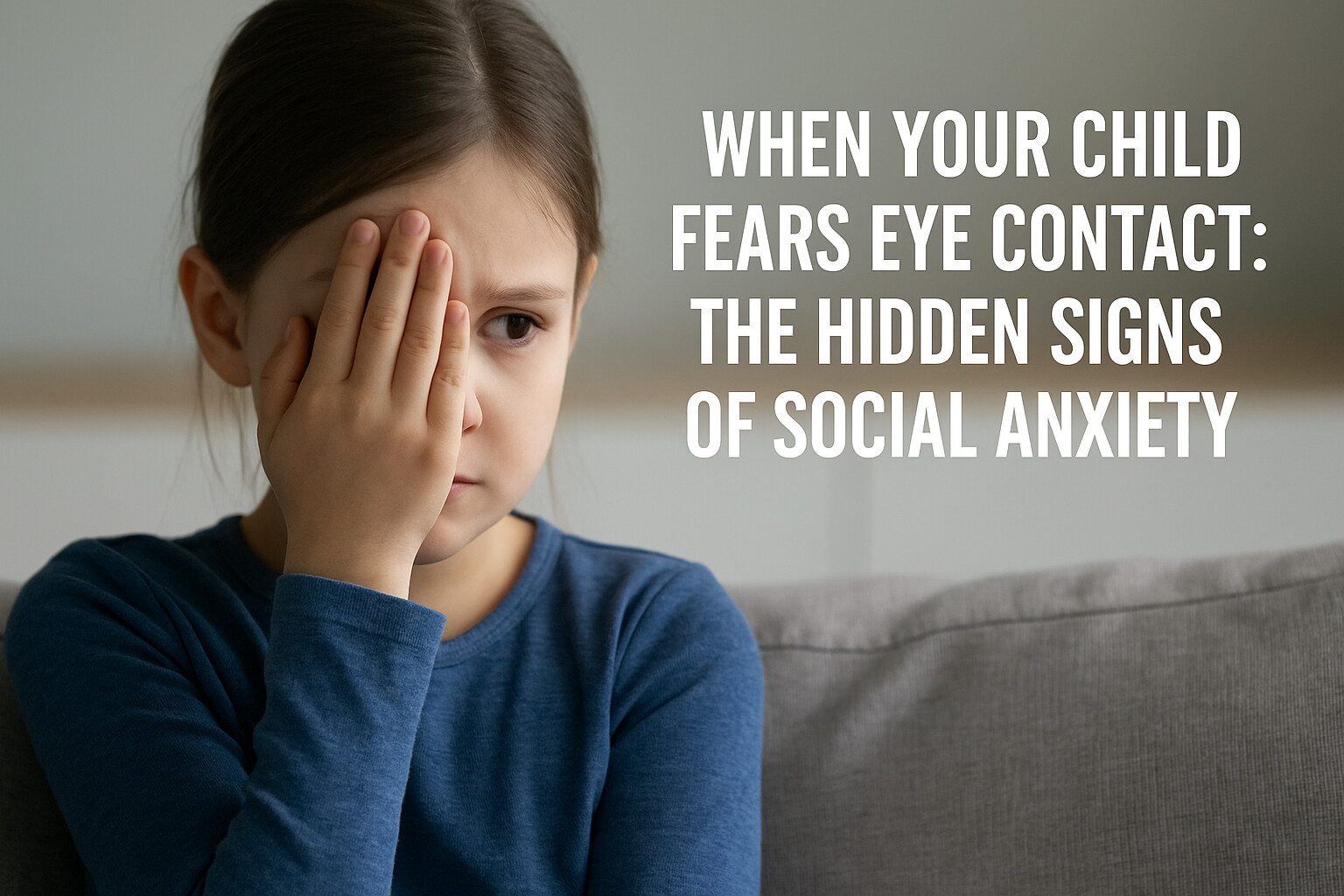
Avoiding eye contact isn’t just a social quirk. It’s often a nervous system in self-protection mode. And in my experience, it’s one of the most misunderstood signs of social anxiety in kids.
This article isn’t going to repeat what you’ve already seen online. I’m not here to list symptoms you could find in a brochure.
I’m here to show you what I’ve learned from thousands of sessions with kids who freeze, look away, or say “I don’t know” when the spotlight is on them.
The kids who seem quiet on the outside but are battling a storm of discomfort inside.
If your child struggles with eye contact, don’t rush to fix it. Understand it first. Let’s start there.
Eye contact isn’t just a polite social gesture. It’s an emotional demand.
When a child looks someone in the eyes, their brain is processing facial expressions, tone of voice, social expectations, and their own internal response all at once. For a socially anxious child, that’s like loading a dozen browser tabs on a system that’s already overwhelmed.
In sessions, I’ve seen children literally flinch when asked to look at someone. Not out of disrespect but out of fear. And here’s the part most people miss:
Avoiding eye contact is often the first sign that a child doesn’t feel emotionally safe.
Let me break down what might be happening in that moment:
To an anxious child, eye contact can feel like standing in front of a crowd. “If they see my face, they’ll know I’m nervous.” They may even feel ashamed of how they look when anxious, something I’ve heard directly in therapy from 9- to 12-year-olds.
Children with heightened stress responses go into fight, flight, or freeze mode during social interactions. Looking down, away, or at an object helps them regulate that overwhelming state. It’s not them being difficult, it’s their body protecting itself.
Many anxious children have a deep fear of embarrassment. If they’ve been teased, scolded, or even gently mocked in past social situations, they learn: “If I look at people, something bad might happen.”
Most parents I meet aren’t ignoring the problem; they’re reacting based on what they’ve been taught.
But when it comes to kids who avoid eye contact, a few common responses actually make the anxiety worse.
It seems like a harmless request. But for an anxious child, it feels like pressure.
I’ve had kids whisper, “I want to look, but I can’t. It’s too much.”
That’s not rudeness, it’s overwhelm. Their nervous system is trying to protect them.
Especially in Indian families, avoiding eye contact can be seen as disrespectful. But anxiety doesn’t care about cultural rules. Guilt won’t fix it, it’ll just add shame to the fear.
Some kids act “fine”, they smile, give short answers, and look near your face, not at it. Parents often say, “She’s just shy.”
What they’re really doing is surviving the moment, masking, not connecting.
Pushing a child to “just say hi” or “go talk to them” may feel right, but without emotional safety, it backfires. They shut down, and the fear grows stronger.
The goal isn’t to force eye contact. It’s to understand why it feels unsafe and start from there.
Most people imagine social anxiety as a child trembling in the corner, refusing to speak. But in reality? It’s quieter than that. Cleaner. Easier to miss.
Here are the signs I look for in session, the ones that often go unnoticed at home or school:
Some kids don’t fidget or pace; they freeze. Hands tight in their lap. Shoulders stiff. Eyes down. This isn’t calm. It’s shut down.
They’ll stall going to recess, hesitate before entering group spaces, or “need the bathroom” whenever social attention builds. These aren’t random delays, they’re escape strategies.
I’ve worked with kids who rehearse what to say before a birthday party… for days. Not because they want to impress because they’re terrified of doing it wrong.
If your child turns every serious moment into a joke or clown act, ask yourself: Is this confidence… or cover?
Here’s the trickiest one. Some socially anxious kids don’t “look” anxious. They’re quiet, polite, and agreeable. Teachers say, “They’re lovely.” But they come home exhausted, irritable, or tearful. That’s the emotional toll of constant self-monitoring.
Therapist’s note: Anxiety doesn’t always shout. Sometimes, it masks as “easygoing.”
Avoiding eye contact doesn’t always mean social anxiety.
And assuming it does? That’s how misdiagnosis happens.
In therapy, we always look at the full picture because social discomfort can come from several different places.
Yes, it’s common. But remember: eye contact is just one piece of it. With social anxiety, you’ll usually see:
This isn’t about fear of judgment, it’s about sensory overwhelm and difficulty reading nonverbal cues. Eye contact might be physically uncomfortable or feel pointless.
A child might say, “Why do I need to look at them if I’m listening?”
I’ve seen this misread too many times: autistic kids labelled anxious, anxious kids flagged for autism. That’s why good evaluation matters.
A rare but real condition where anxiety shuts down both speech and eye contact. These kids often want to connect but can’t. They may speak freely at home, but go silent in public.
Some children aren’t avoiding people, they’re avoiding visual overload. Eye contact means taking in facial expressions, blinking lights, and background motion. It’s too much.
In some cases, avoiding eye contact isn’t social anxiety or neurodivergence. It’s a trauma response. The child may have learned consciously or not that being “seen” isn’t safe.
The point isn’t to guess, it’s to observe. Don’t rush to label. But don’t dismiss it either.
When a child avoids eye contact, most adults respond with pressure:
“Just look at them.”
“Be confident.”
“They won’t bite.”
The intention is good, but it rarely helps. In fact, it often pushes the child deeper into avoidance.
Here’s what actually works based on what I’ve used in therapy rooms for years:
Before you coach your child to “look up,” ask yourself: Do they feel safe in this moment? Or are they bracing for judgment?
Start by making the interaction low-stakes. No spotlight. No audience. Just connection.
Instead of demanding eye contact, offer alternatives:
This removes pressure, but keeps the door to connection open.
In online sessions, I’ve seen anxious kids practice expressions and eye contact through their own camera view. It gives them control over something real-life doesn’t always offer.
You can try this at home too: roleplay conversations over a video call or mirror. It’s less intense and builds confidence.
If your child panics at greetings, parties, or group events, don’t throw them into it. Prepare them.
You don’t grow confidence by pushing. You grow it by supporting them through small, manageable steps.
When anxious kids get through a social situation, adults often say, “See! You did it! You were so brave!”
That sounds helpful, but if your child was masking the whole time, it teaches them to hide harder next time.
Instead, say:
“That looked tough. You got through it. Want to talk about how it felt?”
That builds insight, not pressure.
Let’s be honest, most parents wait too long to seek help. Not because they don’t care, but because they hope it’s “just a phase.” And sometimes it is.
But when a child’s avoidance becomes a pattern, not just occasional discomfort, it’s time to pause and take a deeper look.
If your child is:
…it’s time to talk to someone who understands child behaviour beyond the surface.
Most kids aren’t ready to “talk about their feelings” in session one. And that’s okay.
Here’s how we typically work:
I often tell parents: therapy isn’t about correcting a behavior. It’s about building a safer space inside the child’s own mind and body.
Some of my most withdrawn kids open up faster online. Why?
If your child struggles with in-person settings, online child counselling might be the perfect starting point.
If your child is showing signs of social anxiety or emotional withdrawal, our team at PsychiCare is here to help.
We offer online therapy that’s flexible, child-friendly, and backed by licensed experts with years of experience in child mental health.
👉 Book your first session today.
Not always. It can also be related to autism, sensory issues, trauma, or temperament. But if it’s paired with distress or withdrawal, it should be explored further.
By age 6–7, most children should be comfortable with basic eye contact. But avoidant behavior that persists beyond this age especially in social situations may need support.
Yes. Child therapy helps kids understand their reactions, build confidence gradually, and develop social skills without pressure.
No. It can make it worse. We focus on safety and slow exposure, not pressure.
That’s common. Online therapy gives anxious kids more control, which often helps them engage more honestly and comfortably.
Imagine suddenly feeling a tight, twisting sensation in your stomach that makes it hard to…
Constipation is a common digestive problem that affects millions of people worldwide. Many wonder if…
Broken bones, or fractures, are common injuries that can range from minor hairline cracks to…
A blood clot in the leg, also known as deep vein thrombosis (DVT), can be…
A fever is your body’s natural response to infection, signaling that your immune system is…
The respiratory system is one of the most essential systems in the human body, responsible…


