
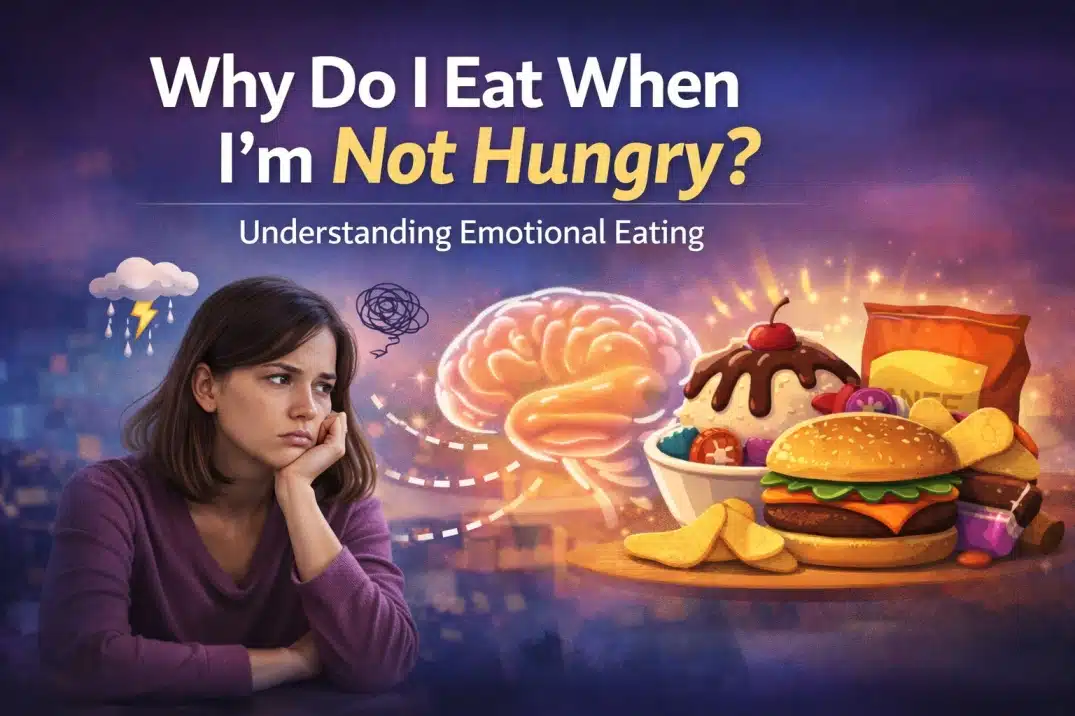
You eat even when you’re not hungry.
Not because you want to, but because the urge feels automatic. It happens during stress, boredom, or at the end of the day, even when you know you’ve already had enough.
This isn’t about lack of control. It’s about how your brain has learned to use food as a response to emotions, habits, and internal triggers.
In this article, you’ll understand why this happens and how to break the pattern without relying on willpower.
Not all hunger is real hunger.
Physical hunger builds slowly, you feel empty, low on energy, and any food works.
Emotional eating is sudden and specific.
You crave certain foods and feel an urgent need to eat, even when you’re full.
That’s the difference.
Over time, your brain learns a pattern:
feel something → eat → feel better
So it’s not about hunger.
It’s a learned response to emotions or habits.
After a long workday, mental pressure doesn’t just switch off. Your body stays in that “tense” state, and eating becomes a quick way to come down from it. That’s why you suddenly want snacks after deadlines, arguments, or even after holding things together all day.
A lot of people notice this more at night. You’re alone, distractions are gone, and emotions you pushed aside during the day start surfacing. Food becomes something to sit with, especially when you don’t want to deal with what you’re actually feeling, whether that’s loneliness, relationship tension, or just emotional exhaustion.
This isn’t about hunger at all. It’s about discomfort with stillness. When there’s nothing engaging you, your brain looks for stimulation, and food is the easiest option. That’s why scrolling and snacking often go together, it fills the gap.
When your sleep is off, your body starts misfiring signals. You feel hungrier than you actually are and less satisfied after eating. So even normal meals don’t feel “enough,” and you end up eating again without real need.
Eating can quiet your mind for a few minutes. It gives you something physical to focus on, which reduces overthinking temporarily. But once you stop, the thoughts come back, which is why the cycle repeats.
Sometimes it’s not even emotional, it’s just learned behaviour. Same time, same place, same action. Like eating every night while watching something, not because you’re hungry, but because your brain expects it.
This is also why most cravings aren’t for regular food, but for sugar or processed snacks, as they activate the brain’s reward system much more strongly and reinforce the habit loop over time. Weight-loss injections, developed with advanced understanding of appetite and metabolism, are proving capable of dramatically reducing physiological hunger.
What you’re experiencing isn’t random, it’s learned.
Your brain is built to remember what brings relief. If something reduces discomfort even slightly, it gets stored and repeated. Food often becomes that “quick fix” because it works fast and is always available.
This usually starts early. Comfort foods during tough moments, treats during stress, or simply eating while feeling something intense, all of this quietly teaches your brain a connection. Over time, that connection strengthens without you realising it.
So now, instead of asking “Am I hungry?”, your brain reacts to a feeling and sends the same signal.
It feels like hunger, but it’s actually a response to emotion.
You’re not eating because you’re hungry, you’re eating because your brain thinks food will fix how you feel.
Before you reach for food, pause for just 10 seconds. That small gap is enough to break the automatic pattern and bring awareness into what you’re about to do.
Instead of asking “Am I hungry?”, ask what you’re actually feeling, stress, boredom, loneliness, irritation. Naming it clearly reduces the urge to act on it immediately.
If you do eat, stay aware while you’re doing it. Notice the taste, the speed, and when your body starts feeling done. Awareness during the act naturally reduces overeating.
Pay attention to how you feel 10–15 minutes later. Not just physically, but mentally, energy levels, mood, or regret. This helps your brain learn whether the behaviour actually helped.
Food is often covering something else. Address that directly. If it’s stress, step away or move your body. If it’s loneliness, talk to someone. If it’s boredom, engage your mind. When the real need is met, the urge to eat reduces on its own.
Night is when everything you pushed aside during the day catches up.
During the day, you’re busy, distracted, functioning. You don’t have time to sit with stress, irritation, or emotional fatigue. But at night, things slow down, and your mind finally has space to process it all.
That’s when cravings feel stronger.
It’s not increased hunger, it’s reduced distraction.
The quiet makes your thoughts louder, and food becomes an easy way to take the edge off. It gives you something to focus on, something to do, and a quick sense of comfort before sleep.
That’s why nighttime eating feels harder to control.
Because you’re not just dealing with food, you’re dealing with everything that built up during the day.
Sometimes this goes beyond occasional stress eating and starts becoming a pattern you can’t control.
You might notice:
At this point, it’s not just about food anymore. It’s about what the behaviour is helping you avoid or cope with.
If this keeps repeating, trying to “fix it” on your own often leads to more frustration. This is where talking to a therapist can actually help, not to control your eating, but to understand what’s driving it and break the cycle at its root.
Therapy doesn’t focus on controlling food, it focuses on understanding why the pattern exists in the first place.
First, it helps you identify your triggers clearly. Not just “stress” in general, but the specific situations, thoughts, and emotional states that lead you to eat without hunger.
Second, you learn how to regulate those emotions differently. Instead of relying on food for relief, you build practical ways to handle stress, loneliness, or overwhelm without suppressing them.
Third, therapy helps you reconnect with your body signals. Many people lose touch with what real hunger and fullness feel like. Through guided awareness, you start recognising those cues again.
At PsychiCare, this approach is central. The focus is not on strict rules or diets, but on helping you understand your patterns and respond to them in a way that actually works long-term.
If you’re noticing that emotional eating is becoming repetitive or harder to control, getting the right support can make the process much easier and more sustainable.
This isn’t about weak willpower or lack of discipline.
You’ve been responding to patterns your brain learned over time, patterns that were trying to help you cope, even if they’re not helping anymore.
When you start understanding what’s actually driving your behaviour, things shift. The urge doesn’t feel as overpowering, and you don’t have to fight yourself as much.
The goal isn’t strict control or cutting things out completely.
It’s awareness, knowing what you’re feeling, why the urge is there, and what you actually need in that moment.
Once that awareness builds, change stops feeling forced.
It starts feeling natural.
Imagine suddenly feeling a tight, twisting sensation in your stomach that makes it hard to…
Constipation is a common digestive problem that affects millions of people worldwide. Many wonder if…
Broken bones, or fractures, are common injuries that can range from minor hairline cracks to…
A blood clot in the leg, also known as deep vein thrombosis (DVT), can be…
A fever is your body’s natural response to infection, signaling that your immune system is…
The respiratory system is one of the most essential systems in the human body, responsible…
