
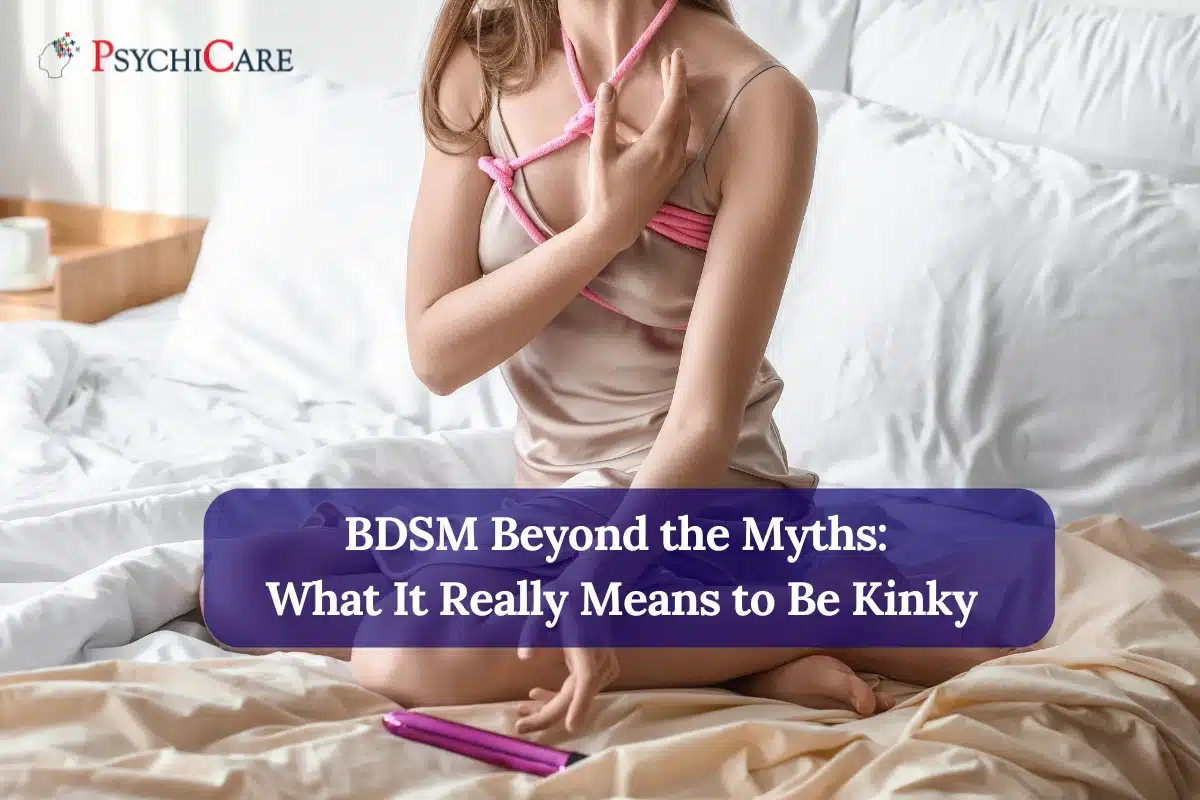
When most people hear the word BDSM, they think of handcuffs, leather outfits, or someone being tied to a bed. Thanks to pop culture, it often gets reduced to a shock factor, which is intense, risky, and maybe even dangerous.
But the truth? BDSM isn’t about pain or power. It’s about trust, communication, emotional safety, and connection. It’s not just a wild night in the bedroom for many people, it’s a way to explore vulnerability, control, freedom, and pleasure on a whole new level.
And yet, despite how common kink is, it’s still misunderstood. People wonder:
In this article, we’ll clear the air by breaking down what BDSM actually means, where the myths come from, how it’s practised safely, and why being kinky isn’t something to hide or fear. And how sex therapy helps!
BDSM stands for Bondage, Discipline, Dominance, Submission, Sadism, and Masochism. But don’t let the words scare you, it’s not just about pain or control.
At its heart, BDSM is about power exchange, not power imbalance. That means both people agree on who takes control, and who lets go, and it’s all based on trust.
It’s not always sexual. For many, BDSM is about intention, emotional safety, and connection. It’s a way to explore roles, sensations, or dynamics that feel exciting but within clear boundaries.
Kink isn’t a disorder or a sign that something’s wrong. In many cases, it’s a powerful way to communicate needs, build intimacy, and safely explore vulnerability.
Let’s clear up some of the biggest BDSM myths, the kind that keep people silent, ashamed, or confused about their desires.
Myth: “Kinky people are damaged”
Truth: Many people who enjoy kink are emotionally healthy, self-aware, and have strong communication skills. In fact, research shows that BDSM practitioners often report lower anxiety and stronger relationships than average.
Myth: “BDSM is just about pain”
Truth: It’s about connection, sensation, trust, and choice. Some play involves impact, but many scenes are soft, playful, or purely emotional. The goal isn’t pain, it’s safe exploration.
Myth: “The dominant controls everything”
Truth: The submissive has just as much power. They set the rules, use safe words, and choose when things stop. Real BDSM is about mutual control, not dominance for dominance’s sake.
Myth: “Submissives are weak”
Truth: Submission takes strength, clarity, and trust. Submissives aren’t passive, they’re often highly self-aware and in charge of what they allow.
Myth: “BDSM is abuse”
Truth: Abuse is non-consensual. BDSM is fully agreed upon, planned, and built on communication. If there’s no consent or emotional safety, it’s not BDSM, it’s a violation.
Myth: “If I’m kinky, something’s wrong with me”
Truth: There’s nothing wrong with being into kink. You’re not broken, you’re just learning what excites you. That’s not shameful. That’s human.
In healthy BDSM, consent isn’t a one-time “yes.” It’s an ongoing agreement before, during, and after every scene. Without it, there is no real kink. Just risk.
Enthusiastic consent is non-negotiable.
This means both partners are fully willing, not pressured, unsure, or doing it just to please the other. In BDSM, nothing should ever feel forced. Curiosity is fine. Silence is not a green light.
Pre-scene communication matters.
Before anything physical happens, there’s a conversation. What are you open to? What’s off-limits? What’s the safe word? You don’t need a script, but you do need to be clear. This is where trust starts.
Aftercare is part of the scene, not an afterthought.
Aftercare means checking in emotionally and physically when a scene ends. That might look like cuddling, space, reassurance, water, or talking through what just happened. BDSM can bring up strong feelings even in gentle scenes. Aftercare helps both people come back to baseline and feel safe again.
Consent doesn’t end once the scene begins.
Just because someone agreed to something earlier doesn’t mean they can’t change their mind. Good kink partners stay tuned in, checking body language, tone, and energy throughout. And if the safe word is used, everything stops. Immediately.
That’s what separates BDSM from abuse: constant, informed, caring consent before, during, and after.
A lot of people think BDSM is all about control, but the truth is it’s about trust. That’s what makes it work. That’s what makes it powerful.
If you’re the dominant one, you’re taking responsibility. You’re reading body language, watching for any shift, and staying fully present. You’re not just in control, you’re creating a space where someone else feels safe enough to let go.
And if you’re the submissive? You’re not giving up power, you’re choosing to trust. That takes guts. That takes self-awareness. Letting someone else lead can be one of the most vulnerable things a person does, and it only works when you know your voice matters the whole time.
You’re saying, “Here’s what I want. Here’s what I don’t. Here’s how far I can go. Can you hold that with care?” And if they can? That kind of exchange builds something strong, not just in the bedroom, but between two people as a whole.
Not because it was “wild” or “hot,” but because they communicated more than they ever have. Because someone finally said, “This is what I need,” and the other person heard them fully.
That’s the part nobody tells you: BDSM is often more about emotional connection than anything else.
And for some people, it’s the first time they’ve ever felt that safe being seen.
If you’re new to kink, it can feel like there’s a whole secret language to learn. The truth is, there’s no one way to do BDSM, but there are ways to start safely. Here are some common types of BDSM play, broken down by what’s easier for beginners and what’s best explored with more experience and trust.
Tying up, using restraints, cuffs, or rope
Acting out scenes like teacher/student, boss/employee, strangers, etc.
Spanking, slapping, paddles, floggers
Using things like feathers, ice cubes, blindfolds, or different textures
Verbal control, praise, humiliation, power language, orgasm denial
Important safety tip:
Just because something seems “simple” doesn’t mean it’s emotionally light. Some of the most intense scenes are verbal or emotional. Always check in before, during, and after.
Yes, when it’s safe and consensual, BDSM can be healthy. Research shows many kinky people have better communication, emotional awareness, and trust in their relationships.
It’s not about harm. It’s about clear roles, consent, and emotional connection. For a lot of people, kink brings them closer to their partner, not further away.
But it’s worth checking in with yourself. If BDSM starts feeling compulsive, emotionally draining, or tied to past trauma, it’s okay to pause. That doesn’t mean kink is the problem, it just means something deeper might need attention.
BDSM is healthiest when it’s intentional, not avoidant and when it helps you feel more connected, not more lost.
Before anything physical happens, have a real conversation. What are you curious about? What are your limits? What would make you feel safe?
Use tools like RACK (Risk-Aware Consensual Kink) or SSC (Safe, Sane, Consensual) to guide your decisions. They remind you to think through risks, stay grounded, and get clear consent every step of the way.
You don’t need chains and blindfolds on day one. Try light roleplay, soft restraints, or sensation play first. Always agree on a safe word and don’t skip aftercare. Emotional check-ins matter as much as what happens during the scene.
There are respectful, consent-focused online communities where you can learn from others without shame. And if you want guidance, a kink-aware therapist can help you explore at your own pace judgment-free.
You don’t have to get it all right from the start. What matters is that you stay honest, safe, and emotionally present for yourself and your partner.
Not everything labeled “BDSM” is healthy. Just because someone calls it kink doesn’t mean it’s safe or okay.
Consent isn’t implied. It’s explicit, enthusiastic, and ongoing. Anything done without it is abuse, no matter what it’s called.
If someone pressures you, ignores your limits, or plays games with your emotions under the excuse of being “dominant,” that’s not power exchange, that’s control.
If your stop word is ignored, or you’re pushed into something you didn’t agree to, that’s a sign of disrespect not kink. Safe words exist for a reason.
If someone uses BDSM to justify humiliation, threats, or emotional abuse outside the scene it’s not about play anymore. It’s about power being used in the wrong way.
Trust your gut. You can always say no, stop, or walk away. Talk to someone you trust. And if it helps, speak to a kink-aware therapist who can help you process what happened without blaming or shaming you.
You deserve safety, respect, and real choice always.
You don’t need to wear leather, hold a whip, or hang out in dungeons to enjoy BDSM. And you definitely don’t need to fit anyone’s idea of what “kinky” is supposed to look like.
Kink doesn’t need to be loud or extreme. It can be quiet, slow, playful, or deeply emotional. It’s about what feels honest and exciting for you not what someone else thinks it should be.
You don’t owe anyone an explanation for what turns you on. As long as it’s safe, consensual, and grounded in respect, you’re allowed to explore it without guilt.
Being kinky isn’t about performing or proving anything. It’s about knowing yourself and maybe, if you’re lucky, finding someone who wants to explore that part of you with care.
Want a safe, shame-free space to explore kink and connection?
Talk to a licensed sex therapist at PsychiCare today.
No judgment. Just support that actually understands.
🔗 Is My Fetish Normal?
A reassuring, expert look at what’s considered “normal” when it comes to sexual preferences.
🔗 How Sexual Fetishism Impacts Your Marriage
Explore how fetishes can affect connection, communication, and trust between partners.
🔗 When Love Languages Clash in Marriage
Understand how mismatched emotional needs can impact physical intimacy too.
🔗 Sex After Having a Baby—Why Does It Feel So Different?
Postpartum sex isn’t just physical — it’s deeply emotional. Here’s what to expect and how to reconnect.
🔗 Emotional Intimacy vs Physical Intimacy
Do you crave closeness but not always sex? Learn the difference and how to balance both.
🔗 I Fantasize About Others While Being Married
Is it harmful or human? A therapist breaks down what fantasies really mean in a committed relationship.
🔗 Mismatched Sex Drives in Marriage
When one partner wants sex more often — how do you find a rhythm that works for both?
🔗 Pain During Sex? Here’s What Might Be Going On
Discomfort isn’t something to push through. Learn the causes and how to get support.
🔗 Why Does Sex Feel Like a Chore?
When intimacy feels more like an obligation than a connection — here’s why.
🔗 Dealing with Disappointment in Marriage
When unmet expectations build up, emotional and sexual disconnect often follows.
🔗 I Don’t Feel Like Having Sex With My Partner
It happens more than you think — here’s how to figure out what’s really going on.
🔗 Had Multiple Sexual Partners But No Desire Now?
A shift in desire doesn’t mean something’s wrong. Learn the deeper reasons and paths forward.
Imagine suddenly feeling a tight, twisting sensation in your stomach that makes it hard to…
Constipation is a common digestive problem that affects millions of people worldwide. Many wonder if…
Broken bones, or fractures, are common injuries that can range from minor hairline cracks to…
A blood clot in the leg, also known as deep vein thrombosis (DVT), can be…
A fever is your body’s natural response to infection, signaling that your immune system is…
The respiratory system is one of the most essential systems in the human body, responsible…


