
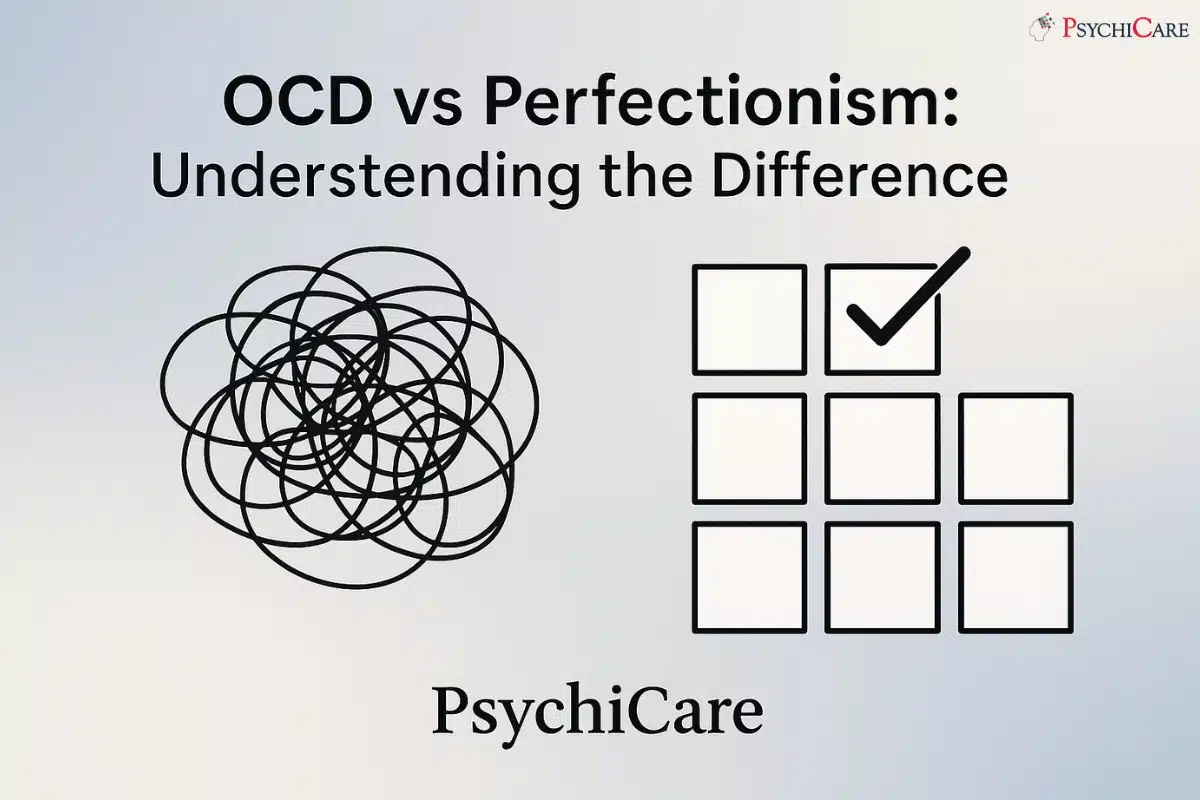
“I’m so OCD about my desk.”
You’ve probably heard that line or maybe even said it yourself. But here’s the thing:
Wanting things clean or organized doesn’t mean you have OCD.
And being a perfectionist doesn’t automatically mean you’re dealing with a mental disorder.
The truth is, OCD and perfectionism are not the same thing, though they’re often confused. Both involve high standards, anxiety, and a desire for control. But one is a diagnosable condition that can severely disrupt your life. The other, while stressful, is often praised or misunderstood as ambition.
If you’ve ever wondered whether your perfectionism is something more serious or whether your “OCD tendencies” might need professional help, this guide will help you draw the line.
In this article, we’ll break down:
Let’s start by getting clear on what OCD actually is and what it’s not.
OCD stands for Obsessive-Compulsive Disorder, a clinical mental health condition that affects how a person thinks, feels, and behaves.
It’s not just about being neat or liking things “just right.”
It’s about feeling trapped in a cycle of obsessions and compulsions that cause distress and interfere with daily life.
People with OCD experience intrusive, distressing thoughts they can’t control. These thoughts aren’t just annoying, they feel threatening, disturbing, or morally wrong.
Common obsessions include:
To cope with the anxiety caused by obsessions, people with OCD perform compulsive actions, often repeatedly, even when they know it’s irrational.
Examples of compulsions:
These rituals are not enjoyable. They feel urgent and often exhausting.
OCD is not a personality quirk; it’s a disorder.
The thoughts and rituals can consume hours of a person’s day, interfere with work or relationships, and lead to depression, fatigue, and isolation.
Perfectionism is a personality trait, not a mental disorder. It involves a strong desire to meet extremely high standards, often for yourself, and sometimes for others.
Many people with perfectionist tendencies strive for excellence, stay organized, and hold themselves accountable. But perfectionism isn’t always healthy.
Unlike OCD, perfectionism doesn’t involve intrusive thoughts or compulsions. However, it can still cause stress, burnout, and relationship issues.
| Healthy Perfectionism | Unhealthy Perfectionism |
| Motivated by growth and pride | Motivated by fear and anxiety |
| Flexible and goal-oriented | Rigid and all-or-nothing thinking |
| Can accept mistakes and move on | Feels crushed by small errors |
| Enhances performance | Leads to procrastination and paralysis |
No, but it can become a problem when it:
In some cases, unhealthy perfectionism overlaps with anxiety, OCD, or even eating disorders, which we’ll explore next.
It’s easy to confuse OCD with perfectionism. Both can involve routines, high standards, and discomfort with mistakes.
But the key difference is this:
OCD is driven by fear and distress. Perfectionism is driven by pressure and expectation.
Let’s break it down more clearly.
Yes. It’s possible to struggle with both OCD and perfectionism, and in some cases, they can reinforce each other.
Someone with perfectionist tendencies may:
When this pressure turns into repetitive behaviors done to reduce anxiety or avoid imagined consequences, it may cross into OCD territory.
Some people with OCD experience a subtype called “perfectionism OCD” or “just-right OCD,” where rituals focus on getting things exactly right to relieve inner tension.
You might be dealing with OCD if:
If perfectionism causes obsessions, compulsions, and distress, it may no longer be “just a personality trait.” It could be part of a larger clinical pattern.
It’s normal to want to do well or feel uneasy about making mistakes. But when that discomfort turns into anxiety, avoidance, or obsession, it’s time to take a closer look.
Whether it’s OCD, perfectionism, or both, you don’t have to manage it alone.
A licensed psychologist can help you figure out what you’re dealing with and guide you toward treatment that works for you.
Struggling to figure out whether it’s OCD or perfectionism? You’re not alone and you don’t have to manage it by yourself.
At PsychiCare, our RCI-licensed therapists and CBT-trained psychologists have helped thousands of clients across the globe gain clarity and feel more in control of their minds.
We offer:
Whether you’re battling intrusive thoughts or stuck in a loop of never feeling “good enough,” real help is available.
Book your session with PsychiCare today and take the first step toward peace of mind.
Imagine suddenly feeling a tight, twisting sensation in your stomach that makes it hard to…
Constipation is a common digestive problem that affects millions of people worldwide. Many wonder if…
Broken bones, or fractures, are common injuries that can range from minor hairline cracks to…
A blood clot in the leg, also known as deep vein thrombosis (DVT), can be…
A fever is your body’s natural response to infection, signaling that your immune system is…
The respiratory system is one of the most essential systems in the human body, responsible…

