
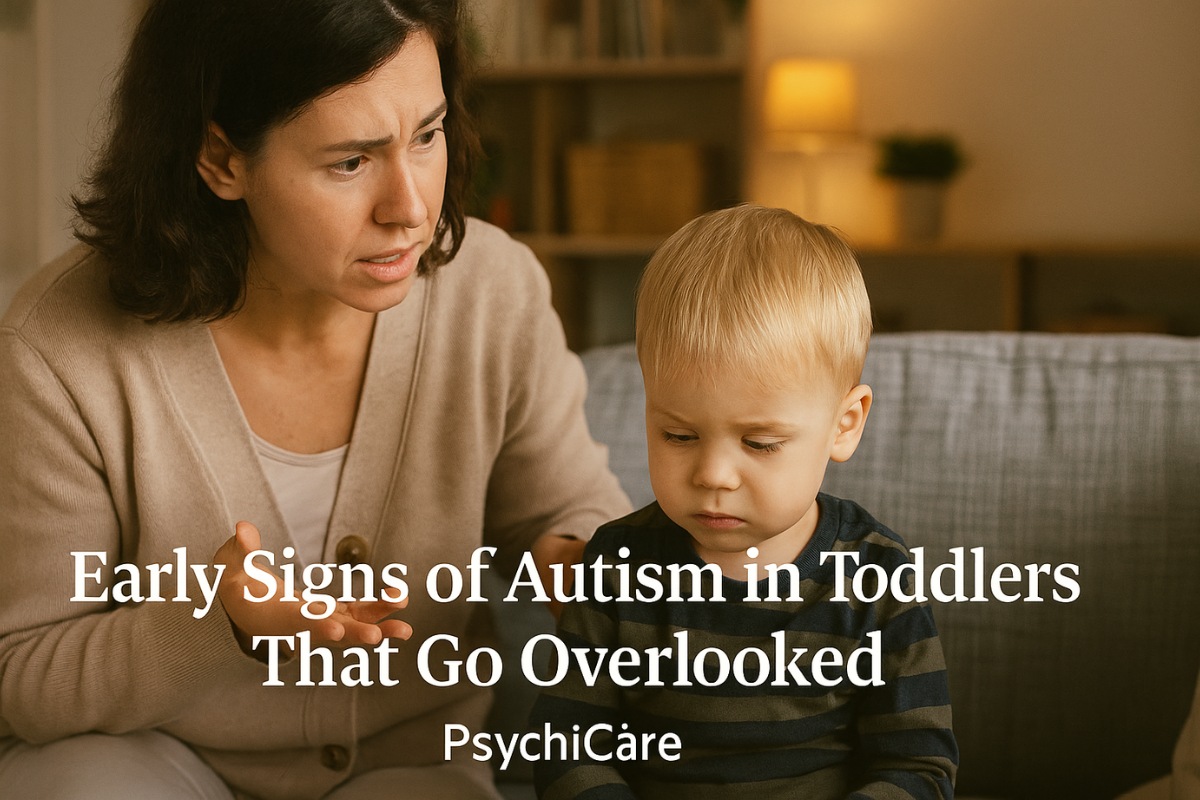
“She makes eye contact, so it can’t be autism.”
“He talks early—but never answers questions.”
“They’re just sensitive, right?”
As child psychologists, we hear these comments almost daily from concerned (and confused) parents. The truth is, autism doesn’t always look like the textbook version, especially in toddlers who speak early, smile, or play with others on the surface.
While most parents associate autism with non-verbal behavior or social withdrawal, the early signs are often much quieter. They hide in the way a child gestures (or doesn’t), how they respond to change, or how intensely they react to everyday sensations.
According to the CDC, autism can be diagnosed as early as age 2, but subtle signs often go unnoticed until much later, especially in girls and children who seem “high functioning.”
In this guide, we’ll unpack:
Most people picture autism as a child who doesn’t speak, avoids eye contact, and prefers to play alone. But in real life, especially before age 5, it rarely looks that simple.
Many toddlers with autism:
These children often fly under the radar because they don’t match the stereotype. And when they’re girls or especially verbal? They’re even more likely to be dismissed as quirky, shy, or “just sensitive.”
Research shows that autistic girls tend to mimic their peers or script conversations from TV shows or adults. This “social copying” hides deeper challenges like:
Just because a child can speak doesn’t mean they can communicate.
Verbal toddlers with autism may:
Some signs of autism are obvious—no eye contact, no speech, isolating behavior. But many early indicators are easy to overlook, especially in toddlers who are affectionate, verbal, or seem “bright.”
Here are the less-obvious signs we see in the clinic all the time:
By 12 months, most toddlers point, wave, and show you things they like.
Autistic toddlers may not:
It’s not always hearing. It’s that the child may be so absorbed or neurologically disconnected that your voice doesn’t register as socially relevant.
Instead of pretend play (feeding a doll or making car noises), you may see:
Contrary to myth, many autistic children do give eye contact, it just may be:
Parents often say, “We knew something felt different, but we didn’t know what to search.”
These are the less obvious, often-overlooked signs that don’t appear in standard screening tools but come up all the time in autism evaluations.
They may seem social in public settings, but watch closely:
You say, “What’s your name?”
They say, “What’s your name?” back.
Or they answer with memorized lines from books or shows, instead of spontaneous replies.
They smile but it doesn’t feel socially timed. It might:
Some kids have an intense interest in:
It may look advanced, but if they can’t talk about anything else, it might be a red flag, not a genius signal.
Many parents wait because they’re told things like:
“Every child develops at their own pace.”
“Boys talk late.”
“She’s just a perfectionist.”
But here’s what we’ve seen in practice: the earlier autism is understood, the easier it is to support.
You don’t need a diagnosis to begin helping your child feel safer, seen, and supported. In fact, the sooner you start adjusting your approach, the easier it becomes to reduce stress for both of you.
Here are therapist-backed strategies you can use right away:
Start noting what triggers meltdowns, what calms them, and what behaviors repeat. This helps:
Children on the spectrum may struggle with figurative or vague speech.
Instead of: “Be good today”
Try: “Keep your hands to yourself and wait for your turn.”
Even basic routines—same cup, same bedtime story—help reduce anxiety in children who crave sameness.
Raising a child with undiagnosed or misunderstood needs is draining.
Therapy, parenting workshops, or just speaking to a professional can make a big difference.
At PsychiCare, we don’t treat children like a diagnosis, we support them as whole people. Whether your child is already diagnosed or just showing signs, our team uses gentle, evidence-based methods that meet them exactly where they are.
For toddlers and preschoolers, therapy often starts with play, not pressure. Through toys, games, and movement, children learn to express emotions, build connections, and explore social routines.
Our speech therapists focus on more than just vocabulary. We help children:
We don’t just work with the child—we work with you. Our psychologists teach simple, clear tools to:
We believe early support is powerful—not just for milestones, but for relationships, confidence, and daily peace.
👉 Explore our Child & Adolescent Clinic to learn more.
If you’ve been wondering whether your child’s quirks are something more, trust that instinct. You’re not overthinking. You’re noticing.
Autism doesn’t always shout. Sometimes it whispers in routines, reactions, and quiet social disconnects. And when caught early, it doesn’t just change the child’s life, it transforms the whole family’s story.
You don’t need all the answers today.
You just need a place to start.
💬 We’re here to help. Connect with a child psychologist at PsychiCare and take the next step gently, together.
Imagine suddenly feeling a tight, twisting sensation in your stomach that makes it hard to…
Constipation is a common digestive problem that affects millions of people worldwide. Many wonder if…
Broken bones, or fractures, are common injuries that can range from minor hairline cracks to…
A blood clot in the leg, also known as deep vein thrombosis (DVT), can be…
A fever is your body’s natural response to infection, signaling that your immune system is…
The respiratory system is one of the most essential systems in the human body, responsible…

