
Perseverative Thinking Test (PTQ) – Free Online Assessment

Perseverative thinking is a psychological term for repetitive negative thinking, when the same worries or intrusive thoughts keep looping in your mind. This pattern is closely linked with rumination, anxiety, and depression, and can make everyday life feel overwhelming.

The Perseverative Thinking Test (PTQ) is a scientifically researched tool designed to measure how often you experience these thought patterns. While it’s not a diagnostic test, it gives valuable insight into the intensity of your thinking style and whether repetitive negative thinking might be affecting your mental well-being.

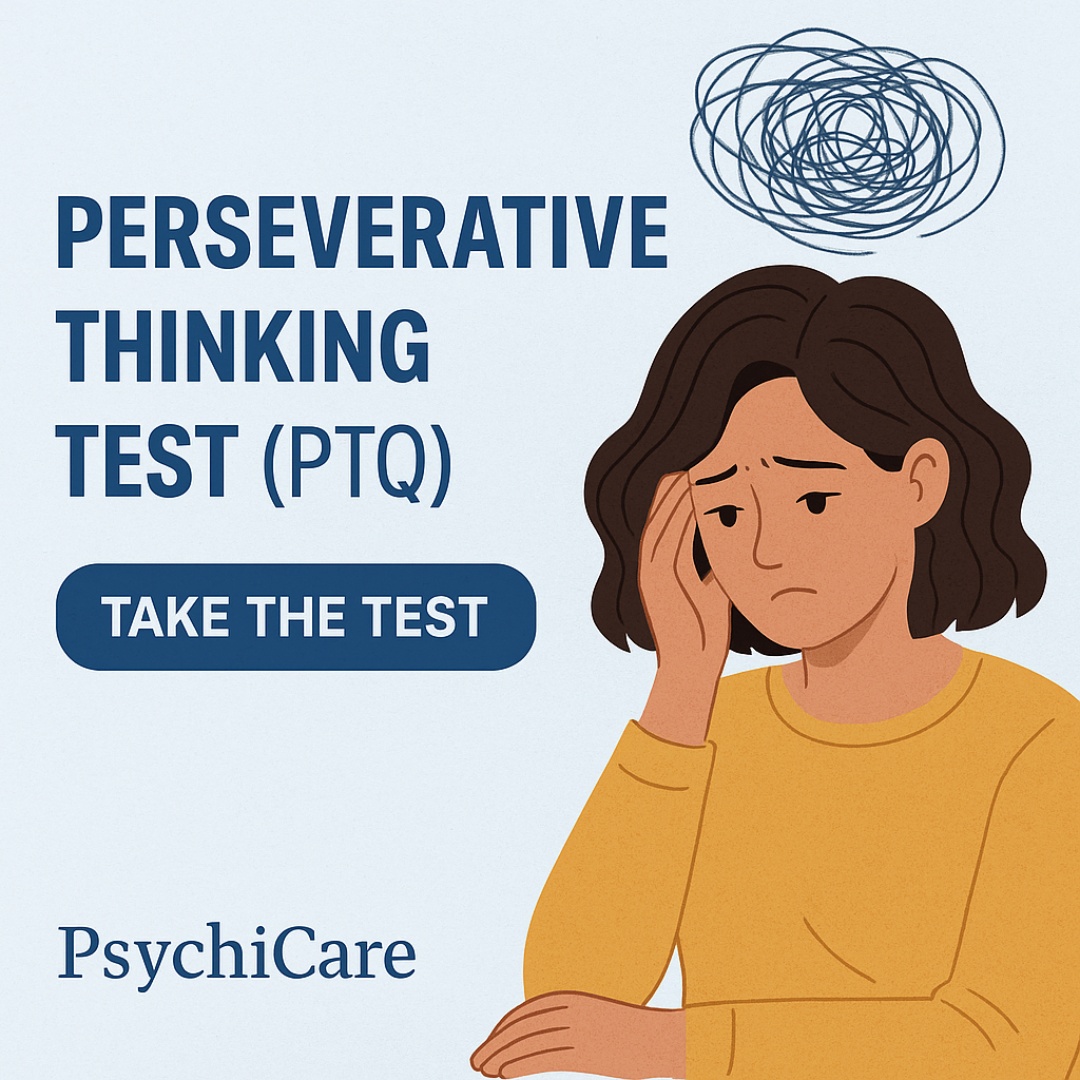
Illustration of an anxious woman with thought scribbles above her head promoting the Perseverative Thinking Test (PTQ), a free online assessment by PsychiCare.
Perseverative Thinking Test (PTQ) – PsychiCare

Perseverative Thinking Test (PTQ)

This 15-item test is designed to assess repetitive negative thinking, also known as perseverative thinking.

Scoring scale: 0 = Never, 1 = Rarely, 2 = Sometimes, 3 = Often, 4 = Almost Always

What is Perseverative Thinking?

Perseverative thinking refers to a mental pattern where the same thoughts repeat themselves again and again, often without leading to solutions or relief. Unlike healthy reflection, this cycle of thinking tends to be intrusive, difficult to control, and emotionally draining. Psychologists describe it as a form of repetitive negative thinking, closely related to rumination and worry.

For example, someone experiencing perseverative thinking might keep replaying a past mistake, constantly question their own decisions, or imagine worst-case scenarios even when nothing is wrong. Over time, this type of thinking is linked to stress, anxiety, depression, and sleep problems, making it an important area to assess and manage.

Perseverative Thinking Questionnaire (PTQ)

The Perseverative Thinking Questionnaire (PTQ) is a validated research tool created by psychologists to measure repetitive negative thinking. It contains 15 statements that describe common patterns, such as getting stuck on problems, having intrusive thoughts, or replaying the same issues without resolution. Each statement is rated on a 5-point scale from 0 (Never) to 4 (Almost Always).

By adding up the scores, individuals can get a sense of whether their thinking falls in the low, moderate, or high range of perseverative thinking. While the PTQ is widely used in psychological studies and clinical practice, it is also useful as a self-reflection tool to better understand how thought patterns may be influencing mood, focus, and overall well-being.

Perseverative Thinking Examples

Perseverative thinking can show up in many areas of life, and it often feels like your mind is “stuck on repeat.” Here are a few common examples:

  • Academic stress: A student keeps replaying exam questions long after the test, worrying about mistakes even before results are released.
  • Relationships: Someone replays a conversation with their partner, wondering if they said the wrong thing, and struggles to move on from the thought.
  • Work pressure: After a performance review, an employee repeatedly rethinks every comment from their manager, imagining negative consequences.
  • Health anxiety: A person fixates on minor symptoms, constantly questioning if they signal something serious.
  • Future worries: Instead of making a decision, someone spends hours imagining every possible bad outcome until they feel paralyzed.

These examples highlight how perseverative thinking is different from normal problem-solving. Instead of helping you take action, the thought loop keeps you trapped, often increasing stress rather than reducing it.

Perseverative Thinking Questionnaire PDF & Scoring

The official Perseverative Thinking Questionnaire (PTQ) is available in PDF format and is often used by researchers, therapists, and students of psychology. It provides a structured way to measure repetitive negative thinking using the same 15 items scored on a 0–4 scale. You can find the PTQ PDF here if you’d like to review the original version.

When scoring the PTQ, responses are added together to create a total score ranging from 0 to 60. Lower scores suggest occasional or well-controlled intrusive thoughts, while higher scores indicate frequent, persistent, and hard-to-control thought loops. In clinical settings, higher PTQ scores are often linked to conditions such as anxiety and depression, making it a valuable screening tool alongside professional evaluation.

Illustration of an anxious woman with thought scribbles above her head promoting the Perseverative Thinking Test (PTQ), a free online assessment by PsychiCare.

FAQs About the Perseverative Thinking Test (PTQ)

Perseverative thinking is a pattern of repetitive negative thoughts that are difficult to control. Unlike problem-solving, these thoughts loop without resolution and are often linked to rumination, anxiety, and depression.

The PTQ measures how often you experience repetitive negative thinking. It focuses on intrusiveness of thoughts, inability to disengage from them, and the perceived unproductiveness of the thought process.

Each of the 15 items is rated from 0 (Never) to 4 (Almost Always). Scores are added to create a total between 0 and 60. Low scores suggest minimal perseverative thinking, while high scores indicate frequent, hard-to-control thought patterns.

The original PTQ can be accessed in PDF format from research sources, such as this version. It is commonly used in psychology studies and therapy settings.

Examples include replaying an argument in your head for hours, worrying about past mistakes, or fixating on worst-case scenarios about the future. These thought loops rarely lead to solutions but often increase stress and self-doubt.

The PTQ is a scientifically validated tool used in psychological research. While it provides useful insights, it is not a diagnostic test. A licensed mental health professional should be consulted if repetitive negative thinking is affecting daily life.

Overthinking is a broad term often used casually, while perseverative thinking is a clinical concept. Both involve repetitive thoughts, but the PTQ specifically assesses negative, intrusive, and unproductive thinking patterns.

High PTQ scores do not diagnose a condition but may signal vulnerability to anxiety, depression, or other mental health challenges. They highlight when professional support may be helpful.