Last Updated on November 2, 2026
Your manager sends a message asking to discuss a mistake in your work. Within seconds, your stomach tightens. You feel frightened, ashamed, and unable to think of a reply.
You read the message again. There’s no threat or insult, but the feeling reminds you of how you felt years ago when mistakes led to shouting or punishment.
Why can an ordinary interaction bring back such intense emotions, even when you know the situation is different?
What Is an Emotional Flashback, and What Does It Feel Like?
An emotional flashback is a term used to describe the sudden experience of emotions associated with earlier trauma, sometimes without a clear visual memory of what happened.
For example, someone who experienced repeated intimidation may feel frightened and helpless when another person raises their voice. Someone who was frequently humiliated may experience overwhelming shame after criticism.
These reactions can involve shaking, a racing heartbeat, difficulty concentrating, or feeling unable to speak. A person may recognise their present surroundings while experiencing emotions that resemble an earlier threatening situation.
Can emotional flashbacks happen without memories?
Trauma-related re-experiencing does not always involve vivid images. Sometimes the emotional experience is more prominent than the visual memory.
However, unexplained fear or shame does not prove that someone has forgotten or suppressed trauma.
Emotional flashback is a descriptive term, not a standalone psychiatric diagnosis. Although it is commonly discussed in relation to PTSD and complex PTSD, these conditions require a broader clinical assessment.
Why Can a Small Situation Trigger Such a Strong Reaction?
A sound, facial expression, smell, or interaction can resemble something associated with a previous threatening experience.
For someone who experienced intimidation, a raised voice may become a reminder of earlier danger, even when the person speaking today has no intention of causing harm.
This can happen because the brain learns associations between particular cues and threatening situations. Encountering similar cues later may activate an emotional and physical response.
But the present circumstances matter.
If someone is currently being threatened or mistreated, their fear may be an appropriate response to real danger. Similarly, criticism can provoke anxiety, embarrassment, or insecurity without involving trauma-related re-experiencing.
When a sense of danger persists beyond individual episodes, it may involve hypervigilance, where someone remains unusually alert to possible threats.
The cause of an emotional reaction depends on the person’s history and present circumstances, not simply how strongly they react.
Emotional Flashback vs Panic Attack: What’s the Difference?
Several emotional experiences can look similar from the outside.
| Experience | Main distinction |
|---|---|
| Emotional flashback | A possible sense of re-experiencing emotions associated with earlier trauma |
| Panic attack | A sudden surge of intense fear or discomfort, often with physical symptoms such as palpitations or breathlessness |
| Emotional trigger | A reminder that causes distress without necessarily creating a sense of reliving an earlier event |
| Dissociation | Feeling detached from yourself, your surroundings, or your immediate experience |
These experiences can overlap. Someone may experience panic during trauma-related re-experiencing or feel detached while emotionally overwhelmed.
A racing heartbeat, shaking, or crying cannot identify the cause on its own.
If sudden physical fear is your main concern, our guide on anxiety attacks vs panic attacks explains those experiences more fully.
What Should You Do During an Emotional Flashback?
When overwhelming emotions arise, focus on your immediate safety and surroundings rather than trying to understand everything at once.
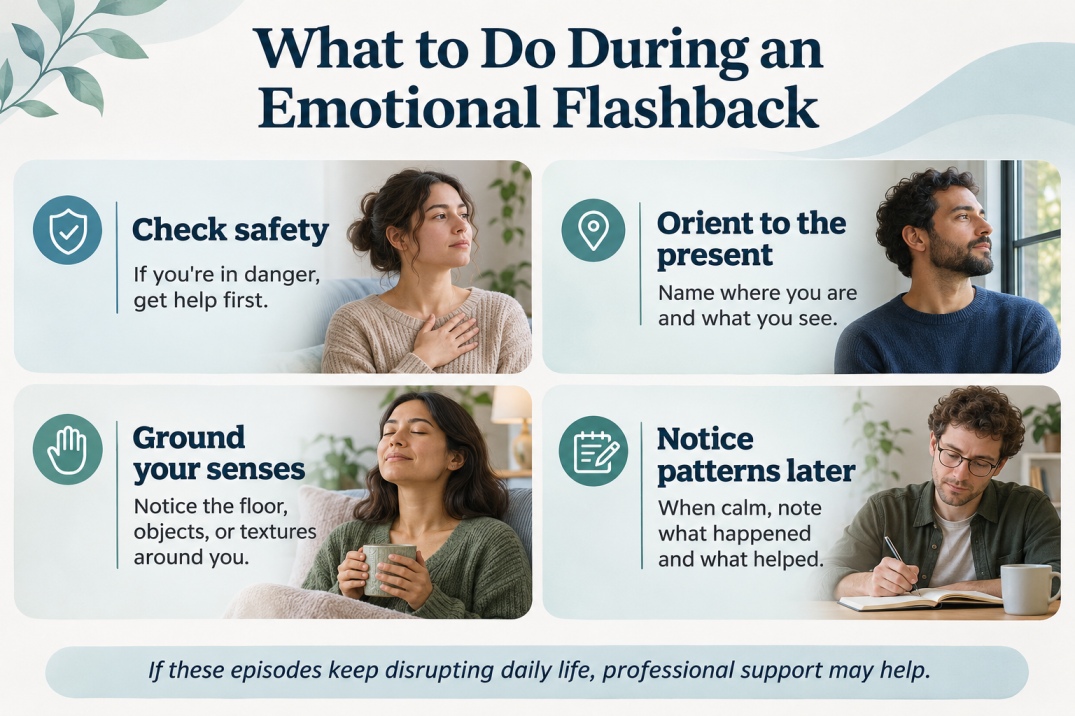
1. Check Your Current Safety
Look at what’s happening around you.
If someone is threatening or harming you, prioritise getting to safety or contacting appropriate help. Don’t assume that every frightening experience is a reaction to the past.
If you’re physically safe, try reorienting yourself to the present.
2. Remind Yourself Where You Are
Identify your location, the current date, and what you’re doing.
You might say:
“I’m in my office. I’m looking at my computer. I’m not in the situation where I was threatened before.”
Use details that are true for you. Looking at familiar objects can also help you reconnect with your surroundings.
3. Use a Grounding Technique That Feels Manageable
Press your feet against the floor, describe three objects you can see, or focus on the texture of something you’re holding.
These exercises direct attention toward your current environment rather than distressing sensations or memories.
Grounding doesn’t work equally well for everyone. If focusing on your body increases discomfort, try an external object or another method.
The NHS inform PTSD and CPTSD self-help guide provides further guidance on managing trauma-related experiences.
4. Notice Patterns Afterward
Once you feel more settled, think about what happened immediately before the reaction.
Was there a particular interaction, sound, or situation? Have similar episodes happened before? What helped you regain your bearings?
A brief record may help you identify recurring patterns or explain your experiences during therapy. You don’t need to force yourself to recall traumatic memories.
If difficulties managing strong emotions extend beyond these episodes, our guide to emotional regulation covers that issue separately.
When Do Emotional Flashbacks Need Professional Help?
Consider seeking professional assessment if these episodes repeatedly interfere with work, relationships, sleep, or everyday responsibilities.
For example, you might avoid meetings because criticism feels unbearable, withdraw during disagreements, or experience significant confusion or detachment that makes it difficult to resume normal activities.
A mental health professional can examine your symptoms, relevant experiences, and current circumstances to understand what’s contributing to these reactions.
If PTSD is diagnosed, established treatments include trauma-focused cognitive behavioural therapies, Cognitive Processing Therapy (CPT), and Eye Movement Desensitisation and Reprocessing (EMDR).
These approaches have evidence for treating PTSD. They should not be described as guaranteed cures for every experience labelled an emotional flashback.
Treatment may also address avoidance, self-blame, and difficulties managing emotions. The most appropriate approach depends on the assessment and the underlying condition.
If trauma-related symptoms are affecting your everyday life, online therapy for PTSD and complex PTSD may provide access to professional assessment and appropriate psychological treatment.
Final Thoughts
A sudden feeling of fear, shame, or helplessness may be connected to an earlier traumatic experience, but it can have other explanations.
If these reactions keep disrupting your life, understanding their pattern and seeking an appropriate assessment can help you address what is actually happening.