
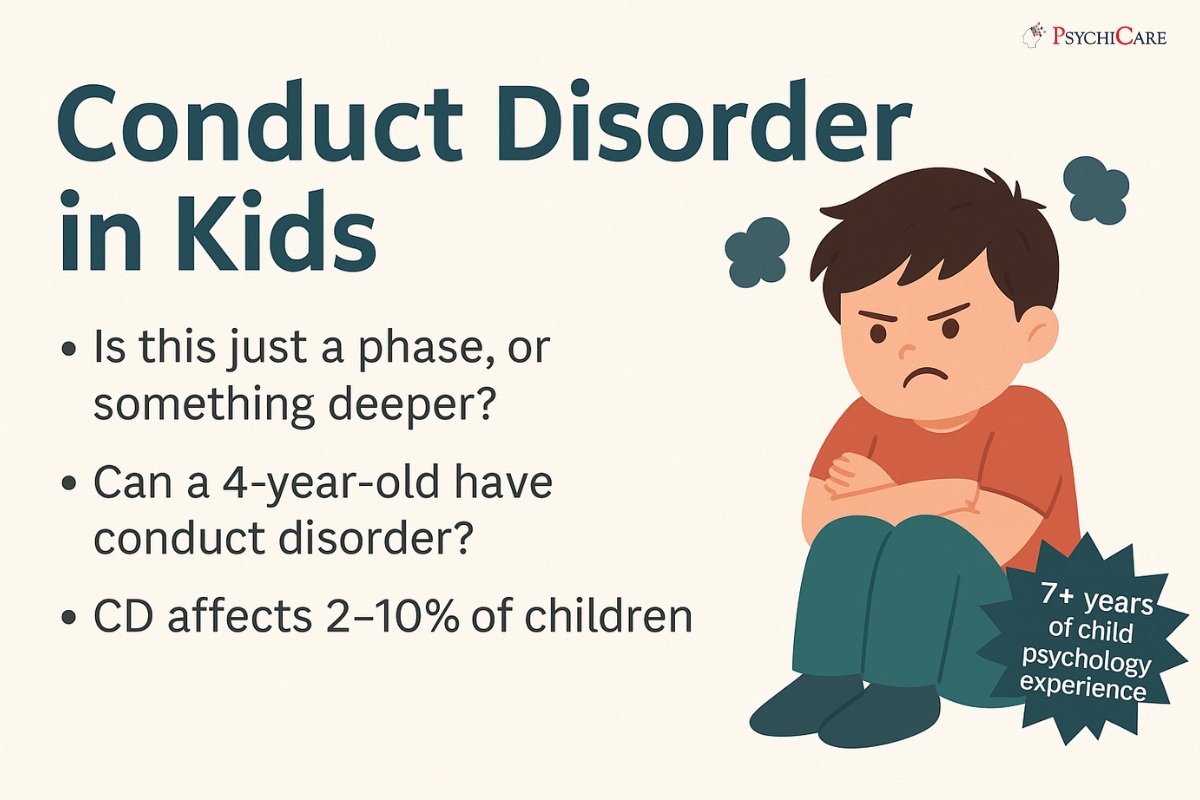
Is your 4-year-old hitting, lying, or showing zero guilt after hurting others?
Do you feel like nothing, no time-outs, no rewards seem to work?
You’re not just dealing with a strong-willed child. In some cases, these can be early signs of conduct disorder.
It’s rare, but yes, even preschoolers can show serious behavioural red flags. Around 2 to 10 per cent of children may have conduct disorder, but many go undiagnosed for years.
As a child psychologist, I’ve seen how early help can change everything. Let’s talk about what’s normal, what’s not, and when it’s time to take that gut feeling seriously.
Conduct disorder is more than just bad behaviour. It’s a mental health condition where a child repeatedly breaks rules, hurts others, and shows little or no remorse. It often involves aggression, defiance, destruction of property, or serious lying, and it’s persistent, not just occasional.
In children under 10, this is called “childhood-onset conduct disorder”. It’s less common in preschoolers, but when it appears, the behaviours are usually more intense and long-lasting.
To be diagnosed, a child must show at least three or more of the following behaviours over 12 months, with one happening in the past six months:
And these behaviours aren’t just occasional, they’re frequent, extreme, and harmful to others.
All kids misbehave. But with conduct disorder:
This isn’t about bad parenting. It’s a pattern that needs professional attention, and early intervention can make a huge difference.
Not all signs look the same at every stage. Conduct disorder can start early, often in subtle but worrying ways. Here’s what to look for at different ages:
Many parents at this stage wonder, “Isn’t this just typical toddler behaviour?”
The difference is intensity, frequency, and lack of empathy.
These kids often get labelled as “troublemakers,” but punishment without proper diagnosis rarely helps. In fact, it can make things worse.
By this stage, the disorder becomes harder to treat, especially if it wasn’t addressed early. That’s why preschool signs matter, they’re the best window for change.
Parents often confuse conduct disorder with oppositional defiant disorder (ODD), and that’s completely understandable. Both involve defiance and anger. But there’s one key difference: ODD doesn’t involve serious harm to others.
Here’s a clear breakdown:
| Feature | Oppositional Defiant Disorder (ODD) | Conduct Disorder (CD) |
| Anger & Defiance | Frequent | Frequent |
| Aggression | Verbal or emotional | Physical and severe |
| Harming Others | Rare | Common (people or animals) |
| Breaking Rules | Mild (arguing, refusing) | Serious (theft, vandalism) |
| Remorse | Usually feels bad after | Often shows no guilt |
| Risk Level | Less likely to lead to legal or school trouble | Higher risk of police or school involvement |
A child with ODD may argue, scream, or refuse to follow instructions, but they usually care about how their actions affect others. A child with conduct disorder, on the other hand, may laugh after hurting someone or destroy things on purpose, and feel nothing.
Mislabeling conduct disorder as ODD can delay the right treatment. Conduct disorder needs more structured support, including therapy that addresses empathy, impulse control, and behaviour patterns early on.
There’s no single reason why a child develops conduct disorder. It’s usually a mix of how their brain works, what they’ve been through, and the world around them.
Here’s what research and real life tell us:
Let’s be clear: you didn’t cause this. But parenting can make things better or worse.
What makes it harder:
What helps:
Parenting a child with conduct disorder isn’t about being strict or soft. It’s about being calm, clear, and consistent, even when it feels impossible.
These kids often push every limit, and typical discipline usually doesn’t work. But with the right tools, change is possible.
Too many rules overwhelm. Choose 3–5 non-negotiables (like “No hitting,” “Use kind words,” “Clean up after play”) and stick to them.
If a rule is broken, calmly apply a consequence. No yelling, no begging. Just action.
Reacting with anger adds fuel. Your calm is their safety signal even when they’re out of control.
Kids with CD hear “No” all day. Catch them doing the right thing, even if it’s small:
“Thanks for putting your shoes away.”
“I noticed you didn’t yell just now. That’s great.”
Don’t argue. Don’t lecture. If they’re pushing your buttons, step away, not in.
Every child misbehaves sometimes. So, how do you know if it’s conduct disorder, or just a rough phase?
The key is pattern and severity. If the behaviour is frequent, harmful, and not improving with discipline, it’s time to take a closer look.
If any of this sounds familiar, an evaluation can help you understand what’s really going on.
A mental health professional may use:
They’ll compare your child’s behaviour to criteria from the DSM-5 (a clinical guide used by psychologists and psychiatrists). To be diagnosed, the child must show a pattern of at least 3 serious behaviours (like aggression, cruelty, theft, or destruction) over 12 months.
If your child has conduct disorder, there is help. With the right treatment, kids can learn better ways to handle emotions, build trust, and reconnect with others.
The earlier you start, the better the outcomes.
The most effective treatments focus on both the child and the family.
Teaches parents how to respond to behaviour in consistent, calm, and clear ways. It’s one of the best tools for conduct disorder.
Helps the child learn how to:
Special programs in school can provide structure and social skills training. Many kids with CD also have learning or attention issues that need to be addressed.
Medication isn’t the first choice, but it may help in severe cases, especially if the child also has:
This should always be part of a larger treatment plan, not a quick fix.
Waiting only makes the behaviour harder to treat. Kids don’t “grow out of” conduct disorder without support. But they can grow with the right tools, safety, and care.
Even small changes in behaviour can lead to big shifts in family life.
If your child’s behaviour feels extreme, unsafe, or beyond your control, early intervention truly matters. At PsychiCare, our expert child psychologists offer trusted online therapy in cities across India, including Delhi, Mumbai, Bangalore, Chennai, Pune, Hyderabad, Kolkata, and Coimbatore. We also support families globally with therapy access in Singapore, Canada, and the Netherlands.
For more detailed clinical information, you can also refer to the AACAP’s Conduct Disorder Resource Centre, a trusted guide from the American Academy of Child and Adolescent Psychiatry.
Conduct disorder in kids is a mental health condition where a child shows repeated patterns of aggressive, harmful, or rule-breaking behaviour. It often includes hitting, lying, stealing, or cruelty to others.
A child may have conduct disorder if they frequently hurt others, break rules, show no guilt, and don’t respond to discipline. A diagnosis can only be made by a mental health professional.
Yes, a 4-year-old can have conduct disorder, though it’s uncommon. Early signs may include severe aggression, destruction of property, and a lack of remorse.
Yes, children as young as five can be diagnosed with conduct disorder if their behaviour is extreme, persistent, and harmful to others.
Conduct disorder can develop due to a mix of brain differences, genetics, trauma, parenting challenges, and environmental stress. No single cause is responsible.
Yes, conduct disorder is a real and clinically recognised mental health condition listed in the DSM-5.
Conduct disorder affects about 2 to 10 percent of children and teens, with boys being more commonly diagnosed.
Conduct disorder is serious but treatable. It doesn’t mean a child is “bad,” but untreated symptoms can lead to long-term problems without support.
Yes, conduct disorder is classified as a psychiatric disorder that affects a child’s emotions, behaviour, and social functioning.
Yes, conduct disorder is both a psychological and psychiatric disorder that involves emotional and behavioural problems in children and adolescents.
Conduct disorder is a disruptive behaviour disorder that involves ongoing patterns of aggression, defiance, and violation of rules or others’ rights.
Conduct disorder in a child is a condition where ongoing aggressive or destructive behaviour causes serious problems at home, school, or with peers.
Conduct disorder in childhood refers to early-onset symptoms such as lying, bullying, and physical aggression that start before age 10.
Conduct disorder in adolescence usually begins after age 10 and includes more serious behaviours like fighting, vandalism, or substance use.
Common symptoms of conduct disorder include aggression, lying, stealing, breaking rules, and showing no remorse for hurtful behaviour.
Imagine suddenly feeling a tight, twisting sensation in your stomach that makes it hard to…
Constipation is a common digestive problem that affects millions of people worldwide. Many wonder if…
Broken bones, or fractures, are common injuries that can range from minor hairline cracks to…
A blood clot in the leg, also known as deep vein thrombosis (DVT), can be…
A fever is your body’s natural response to infection, signaling that your immune system is…
The respiratory system is one of the most essential systems in the human body, responsible…


