Last Updated on November 19, 2026
Your child understands a science lesson and can explain the answers clearly. But when it’s time to write those answers in a notebook, everything slows down.
A few sentences take twenty minutes. Letters are difficult to read, words remain unfinished, and homework becomes a daily struggle.
You may have tried handwriting practice, new notebooks or asking your child to concentrate harder. Yet there is little improvement.
Sometimes, persistent writing difficulties are associated with dysgraphia, which affects handwriting or other aspects of written expression.
But how can you tell whether your child has dysgraphia or simply needs more writing practice? Understanding the signs and assessment process can help you decide what to do next.
What Is Dysgraphia in Children?
Dysgraphia is a term used to describe significant difficulties with handwriting and, depending on the clinical or educational definition, other aspects of written expression.
Writing requires several skills to work together. A child needs to remember letter shapes, coordinate hand movements, spell words, organise ideas and construct sentences.
A difficulty in any of these areas can affect written performance.
Some children struggle mainly with forming letters and maintaining writing speed. Others have greater difficulty with spelling, grammar or expressing their thoughts in writing.
Clinically, these problems are not always classified under one diagnosis. Under DSM-5-TR, persistent difficulties involving spelling, grammar, punctuation or organising written expression may fall under Specific Learning Disorder with impairment in written expression.
Handwriting problems caused primarily by motor coordination difficulties may require a different or additional evaluation.
Understanding the particular difficulty is important because different writing problems need different forms of support.
What Are the Signs of Dysgraphia in Children?
Dysgraphia can appear differently depending on a child’s age and the writing demands at school.
1. Difficulty With Handwriting and Letter Formation
You may notice that your child:
- Writes letters in inconsistent sizes or shapes.
- Leaves irregular spaces between letters and words.
- Struggles to keep writing aligned with notebook lines.
- Frequently erases or rewrites letters.
- Produces handwriting that becomes less readable when writing quickly.
Some children also have difficulty maintaining a comfortable pencil grip or controlling pencil movements.
These signs should be interpreted alongside the child’s age and experience with handwriting instruction.
2. Problems With Spelling and Written Expression
Your child’s handwriting may be reasonably clear, but their written answers might still be difficult to understand.
They may make frequent spelling mistakes, leave sentences incomplete or struggle to organise information into paragraphs.
For example, a Class 5 student might remember all the important points from a history lesson but find it difficult to arrange them into a structured answer.
This may indicate a difficulty with written language rather than the physical process of handwriting.
3. Slow Writing and Physical Effort
Pay attention to how long written tasks take.
Does your child regularly leave examination answers unfinished despite knowing the material? Do they struggle to copy notes before the teacher moves on?
Some children complain of hand discomfort or become unusually tired during longer assignments. Others begin avoiding writing because it demands so much effort.
An occasional spelling mistake or untidy notebook is not enough to identify dysgraphia. The concern becomes more significant when difficulties persist and interfere with learning despite appropriate instruction.
Is It Dysgraphia or Just Poor Handwriting?
A child can have messy handwriting without having a learning disorder.
Writing skills develop gradually. Young children may struggle with spacing, letter formation and speed while learning to write.
Other factors can also affect performance.
For example, a child with attention difficulties might rush through written work or frequently lose their place. Vision problems may interfere with copying, while difficulties with motor coordination can make pencil control challenging.
Limited opportunities for writing instruction can also contribute to poor performance.
To understand the problem better, consider how your child manages different activities.
Can they copy a short paragraph accurately but struggle to write their own sentences? Does their handwriting become more readable when given sufficient time? Have teachers noticed the same difficulties across several school terms?
A professional assessment becomes more relevant when difficulties continue despite suitable teaching and support, or when they substantially affect classroom performance.
How Is Dysgraphia Assessed in Children?
There is no single test that diagnoses every form of dysgraphia.
A comprehensive evaluation examines the child’s writing abilities, educational history and other factors that might explain the difficulty.
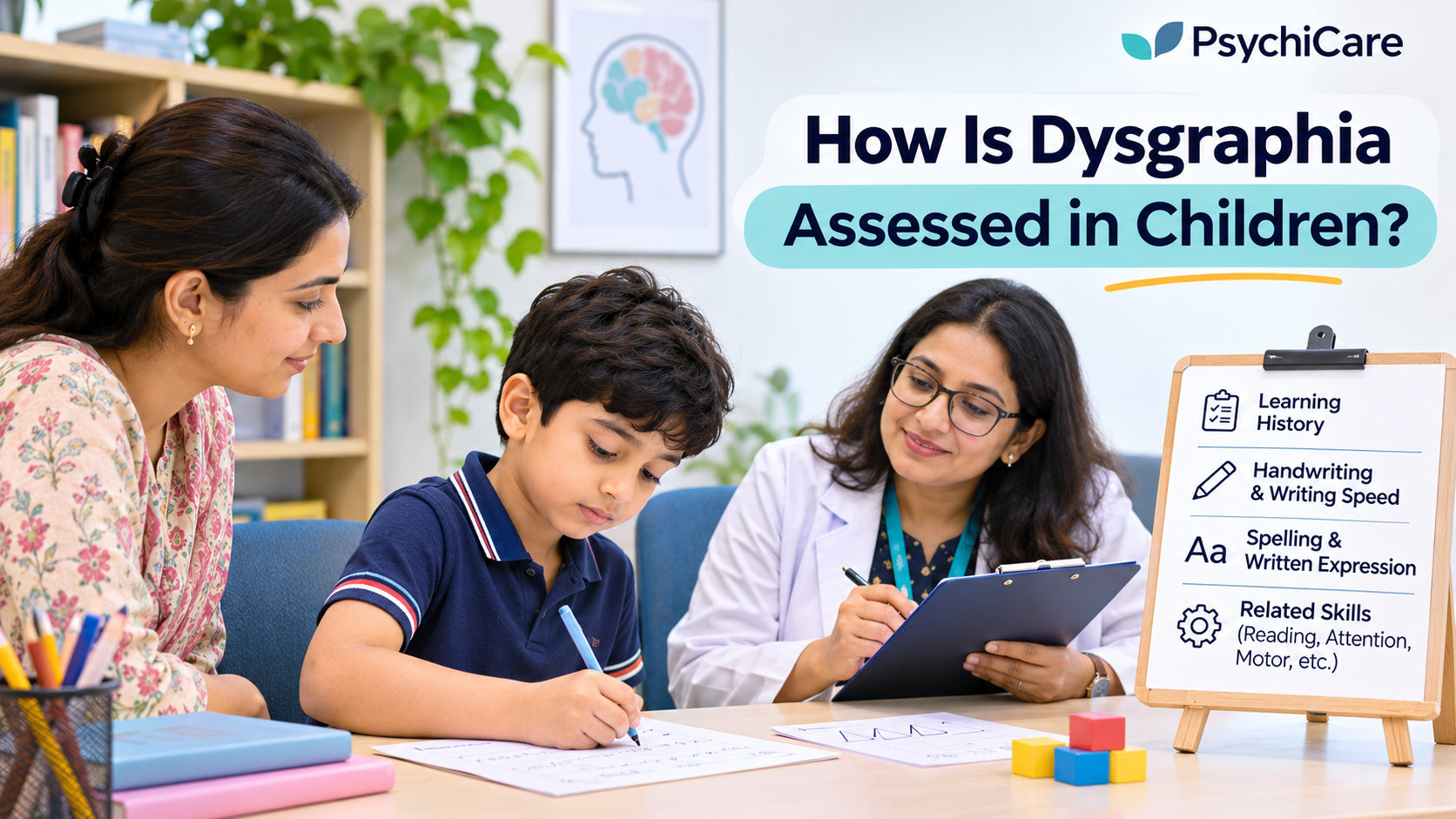
The assessment may include the following areas, depending on the child’s needs.
1. Understanding the Child’s Learning History
The assessment professional usually begins by speaking with parents and reviewing educational information.
They may ask when the writing difficulties first appeared, which activities are most challenging and whether the child has received additional learning support.
School notebooks, examination papers and teacher observations can provide useful evidence.
For example, writing samples collected over several months may show whether the difficulties are consistent or limited to particular classroom situations.
2. Assessing Handwriting and Writing Speed
Your child may be asked to copy letters, words or passages.
The assessor can observe letter formation, spacing, legibility and how efficiently the child writes.
Writing speed matters because a child may produce accurate handwriting but take substantially longer than expected to complete ordinary tasks.
If physical coordination appears to be a concern, further evaluation of fine-motor control, posture and visual-motor integration may be recommended.
3. Evaluating Spelling and Written Language
Assessment activities may include spelling dictated words, constructing sentences or writing a short passage independently.
These tasks help identify whether the main difficulty involves spelling accuracy, sentence construction, grammar or organising ideas.
For example, a child who spells individual words correctly but struggles to compose paragraphs may need a different intervention from someone whose primary difficulty is spelling.
Appropriate standardised tests may be used to compare performance with relevant age and educational expectations.
4. Investigating Related Learning Difficulties
Writing problems sometimes occur alongside dyslexia, ADHD, language difficulties or developmental coordination disorder.
The professional may therefore assess reading, attention, language or cognitive abilities when clinically indicated.
For children in India, the language of instruction also matters. An assessment should consider how long the child has studied in English or another school language, particularly when it differs from the language spoken at home.
The final interpretation should bring together test results, observations and educational history, rather than relying on a handwriting sample or online screening score.
For a broader explanation, read PsychiCare’s guide to what happens in a Specific Learning Disability assessment.
Who Can Assess Dysgraphia in India?
The professionals involved depend on the difficulties identified and whether the purpose is educational support, clinical diagnosis or official disability certification.
An appropriately qualified clinical psychologist may assess learning difficulties and related cognitive concerns. Special educators can evaluate academic skills and help identify suitable instructional strategies.
If handwriting problems appear related to motor coordination, an occupational therapist may assess the physical aspects of writing.
Some children need a multidisciplinary assessment.
Clinical Assessment vs Disability Certification
A psychological assessment report does not automatically qualify as a government-recognised disability certificate.
Under India’s official Specific Learning Disability (SLD) certification guidelines, assessment follows prescribed procedures involving designated professionals and authorities.
The process includes cognitive assessment and specific learning disability testing according to the applicable requirements.
Official certification is available for children aged eight years and above, with reassessment requirements at specified ages.
Parents seeking documentation for school accommodations or examination concessions should confirm the requirements with the relevant school, examination board or authorised certification centre.
You can refer to the Department of Empowerment of Persons with Disabilities’ 2024 assessment guidelines for the government framework.
What Happens After a Dysgraphia Assessment?
An assessment should provide more than a label. Its findings can help parents and teachers decide which skills need attention and how the child can participate more effectively in school.
Understanding the Assessment Report
The report may describe strengths and difficulties involving handwriting, spelling, writing speed or written expression.
Consider two children with different findings.
Child A: Can construct good sentences but writes unusually slowly. Support may focus on handwriting fluency and reducing the burden of lengthy handwritten tasks.
Child B: Writes legibly but has difficulty planning paragraphs and organising ideas. This child may benefit from explicit instruction in sentence construction and written composition.
Both experience writing difficulties, but their educational needs are different.
Remedial Education and Skill Development
Targeted teaching should address the areas identified during assessment.
This might include structured handwriting instruction, spelling strategies, sentence-building exercises or teaching the child how to plan written answers.
Occupational therapy may be useful when motor difficulties are present, but it is not automatically necessary for every child with dysgraphia.
Classroom Support and Accommodations
Depending on individual needs, schools may consider support such as additional writing time, fewer unnecessary copying tasks, access to typed responses or alternative methods of completing assignments.
Formal examination accommodations depend on the relevant board’s eligibility and documentation rules.
The objective is to help the child access learning while continuing to develop appropriate writing skills.
For more information about related conditions, see PsychiCare’s guide to learning disorders in children.
How Can Parents Help a Child Who Struggles With Writing?
You can make homework less frustrating even before a formal assessment is completed.
Start by identifying the most difficult part of the task. Is your child struggling to remember spelling, form letters or decide what to write?
Once you understand the immediate problem, try these approaches:
- Break longer assignments into manageable parts. A paragraph at a time may be easier than completing several pages in one sitting.
- Let your child plan answers verbally. Talking through ideas before writing can help with sentence organisation.
- Separate subject knowledge from handwriting practice. If the task is to understand a science concept, repeated copying may not be the best way to assess learning.
- Discuss suitable adjustments with teachers. Ask whether printed notes, typing or reduced copying might help with particular activities.
- Avoid punishment through repeated rewriting. Making a child copy the same page several times may increase frustration without addressing the underlying difficulty.
Encourage your child to recognise improvements in specific skills, such as completing an answer independently or organising sentences more clearly.
The aim is steady progress, not perfect handwriting.
When Should You Consider a Professional Assessment?
Consider professional evaluation if your child’s writing difficulties have continued over time despite appropriate teaching and support.
You may also want to seek advice when written work regularly remains incomplete, school performance is affected or the child becomes distressed about writing assignments.
You do not need to wait for repeated examination failures.
Speak with the class teacher about what they have observed and what educational support has already been attempted.
A professional can then help determine whether further assessment is needed and which skills should be investigated.
If you’re uncertain about the appropriate evaluation, you can contact PsychiCare’s children’s psychological assessment team to discuss the child’s concerns and available assessment options.
Frequently Asked Questions
At what age can dysgraphia be identified?
Writing difficulties may become noticeable during the early school years. However, formal diagnosis depends on the child’s developmental stage, educational experience and persistence of difficulties.
In India, the official SLD certification framework provides for school screening at eight years of age or Class III, whichever comes earlier. Government disability certification is available from age eight.
You should not wait until your child turns eight to seek educational support if difficulties are already affecting learning.
Is dysgraphia the same as dyslexia?
No. Dyslexia primarily affects accurate or fluent word reading and often spelling, while dysgraphia commonly refers to handwriting or written-expression difficulties.
Both conditions can occur together, which is why an assessment may examine more than one academic skill.
Read how dyslexia is diagnosed in children for a more detailed explanation.
Does every child with dysgraphia need an IQ test?
Not every child with writing difficulties automatically needs an IQ test during an initial educational or clinical evaluation.
The assessment depends on the concern being investigated. However, India’s official SLD disability-certification pathway includes IQ assessment as part of its prescribed process.
Ask the professional whether the purpose is to identify learning needs or obtain formal disability certification.
Can dysgraphia be diagnosed through an online test?
Online checklists may help parents recognise potential concerns, but they cannot establish dysgraphia on their own.
A reliable evaluation may require observation of handwriting, assessment of written-language abilities and appropriate standardised testing.
Some consultations may be conducted remotely, but the professional should determine whether particular tests require in-person administration.
Understanding Your Child’s Writing Difficulties
Persistent writing difficulties deserve attention, especially when they begin affecting schoolwork or your child’s willingness to participate in learning activities.
An assessment can help identify the affected skills and guide the support most likely to be useful.
With appropriate instruction, practical classroom adjustments and cooperation between parents and teachers, children can receive support that reflects their individual learning needs.
The important first step is understanding the difficulty rather than assuming that more handwriting practice will solve it.