Last Updated on October 29, 2026
You have an important meeting tomorrow. You feel tense, struggle to sleep, and keep thinking about what could go wrong.
The meeting goes well, but you still can’t relax. Now you’re replaying everything you said and worrying about how others might judge you.
Is this stress or anxiety?
The two can feel almost identical. The difference often becomes clearer when you look at what’s creating the pressure, what you’re afraid might happen, and why your worry continues.
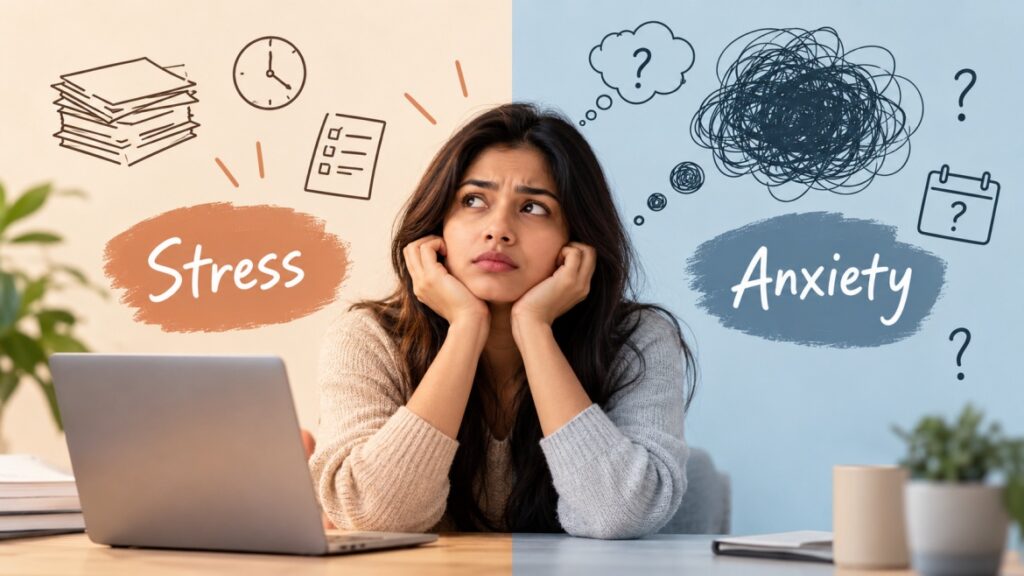
What Is the Difference Between Stress and Anxiety?
Stress is a response to demands or pressures, while anxiety involves apprehension about something that might happen.
For example, having three urgent deadlines can create stress because you’re dealing with an actual workload.
Worrying that one mistake will cost you your job involves anxiety about a possible consequence.
These experiences aren’t completely separate. An important deadline may create pressure and fear about the outcome at the same time.
The National Institute of Mental Health (NIMH) explains that stress and anxiety share many symptoms, although they differ in important ways.
Stress vs Anxiety: Key Differences
| Stress | Anxiety | |
|---|---|---|
| Main experience | Feeling pressured by demands or challenges | Feeling worried or apprehensive about possible danger or unwanted outcomes |
| Common triggers | Workload, financial problems, family responsibilities, major changes | Anticipated failure, rejection, uncertainty, health concerns, perceived threats |
| When it happens | Often during demanding circumstances | Before, during, or after a concerning situation |
| Physical effects | Muscle tension, sleep problems, headaches, digestive discomfort | Many of the same effects, sometimes with pronounced restlessness or physical arousal |
| When the situation improves | May gradually ease, although recovery can take time | May ease, continue, or shift toward another concern |
| Clinical significance | Stress itself isn’t a psychiatric diagnosis | Anxiety is a normal emotion, but certain patterns can meet criteria for an anxiety disorder |
These differences are useful for understanding your experience, but they aren’t diagnostic rules.
Why Do Stress and Anxiety Feel So Similar?
Both involve the body’s response to perceived demands or threats.
When you feel under pressure, your nervous system may become more alert. Your muscles tighten, your heart beats faster, and your attention shifts toward possible problems.
Anxiety can activate similar responses, even when the danger you’re anticipating hasn’t occurred.
That’s why physical symptoms alone usually cannot tell you whether you’re stressed or anxious.
For example, a racing heart before an interview could reflect pressure to perform, worry about rejection, or both.
The meaning of the situation and your response to it provide more information than the symptom itself.
Physical symptoms can also have medical causes. New, persistent, or unexplained symptoms shouldn’t automatically be attributed to stress or anxiety.
Can You Feel Anxious Without Being Stressed?
Yes. You can experience anxiety even when there is no obvious immediate demand.
Imagine your manager schedules a meeting for next week.
Your workload is manageable, and nothing suggests you’ve done anything wrong. Yet you begin imagining criticism, embarrassment, or losing your job.
You replay previous conversations, look for possible mistakes, and find it difficult to concentrate.
You’re responding to an anticipated outcome rather than something that has already happened.
However, this doesn’t mean anxiety is always irrational.
Someone facing genuine financial instability, an uncertain medical situation, or an unsafe relationship may have understandable concerns about the future.
The presence of a real problem doesn’t rule out anxiety.
What matters clinically is the nature of the worry, how difficult it is to manage, whether it fits the circumstances, and how much distress or disruption it causes.
Why Does Anxiety Continue After a Stressful Situation Ends?
Sometimes the original pressure disappears, but your mind continues looking for possible problems.
Consider a student who has finished an important exam.
The preparation and time pressure are over. But the student keeps replaying answers, checking discussions online, and asking friends whether they made the same mistakes.
Each check provides a little relief.

Soon, another uncertainty appears, and the urge to check returns.
Repeated checking and reassurance-seeking can sometimes maintain anxiety because they provide temporary relief without helping someone become more comfortable with uncertainty.
This doesn’t mean reviewing an exam or asking for reassurance once is unhealthy. The concern is a recurring pattern that keeps someone caught in worry.
There is another possibility, too.
After weeks or months of intense pressure, you may remain exhausted, tense, or unable to sleep properly. Recovery from prolonged stress can take time.
So feeling unsettled after an event doesn’t automatically indicate an anxiety disorder.
The useful question is whether you’re gradually recovering or becoming increasingly caught in anticipation, checking, and avoidance.
Can Stress and Anxiety Happen Together?
Yes. A real problem and anxiety about its consequences can occur at the same time.
Financial Difficulties
You have bills to pay and limited money available.
The financial demands create stress. You may also worry about losing your home, disappointing your family, or facing difficulties you cannot predict.
Some concerns may be entirely realistic.
However, after making a reasonable payment plan, you might continue imagining every possible disaster without gaining useful information.
The practical problem and the ongoing worry may require different approaches.
Relationship Conflict
You have an argument with your partner.
The disagreement is stressful. Later, you begin worrying that your partner will leave, even though neither of you has discussed ending the relationship.
You may repeatedly check your messages or seek reassurance.
In this situation, resolving the disagreement and understanding your fear of rejection may both be important.
Stress and anxiety can influence each other without being the same experience.
Can Long-Term Stress Cause an Anxiety Disorder?
Chronic stress can contribute to anxiety difficulties, but it doesn’t inevitably develop into an anxiety disorder.
Someone experiencing months of workplace pressure, caregiving demands, or financial uncertainty may become increasingly tense and worried.
Whether this develops into a clinical condition depends on several factors, including individual vulnerability, previous experiences, the severity of the stressors, and available support.
It’s also important to distinguish anxiety from an anxiety disorder.
Feeling anxious is a normal human experience.
An anxiety disorder involves a recognised pattern of symptoms that meets clinical criteria and causes significant distress or impairment.
For example, generalised anxiety disorder involves excessive, difficult-to-control worry about multiple areas of life, along with other symptoms. In adults, diagnostic criteria generally require worry occurring more days than not for at least six months.
That six-month requirement is specific to generalised anxiety disorder. Other anxiety conditions have different criteria.
You don’t need to wait six months to seek help if symptoms are affecting your life.
What Helps With Stress vs Anxiety?
The most useful approach depends on whether you’re dealing mainly with a pressure that needs attention, repetitive worry, or both.
When a Specific Problem Is Creating Stress
Focus first on what can realistically change.
If your workload is unmanageable, you may need to discuss deadlines, reduce commitments, or request additional resources.
If money is the main concern, a realistic budget or professional financial advice may be more useful than repeatedly trying to relax without addressing the problem.
Rest and relaxation can ease physical tension, but they cannot resolve every stressful situation.
Some pressures are also outside your immediate control. In those cases, practical support and manageable expectations may be more useful than trying to eliminate the stressor entirely.
When Anxiety Keeps You Thinking About What Might Happen
You may have already taken reasonable steps but continue searching for certainty.
For example, you’ve prepared for a presentation, yet you keep reviewing every detail because you’re afraid something will go wrong.
Before checking again, consider whether it will provide information you actually need or simply offer a brief sense of relief.
When worry becomes repetitive, cognitive behavioural therapy (CBT) can help people examine their interpretations, reduce unhelpful checking or avoidance, and respond differently to uncertainty.
Our guide on how to stop overthinking explores related thinking patterns and practical ways to manage them.
When Both Need Attention
Sometimes you need two kinds of changes.
A person experiencing workplace pressure may need a more manageable workload while also addressing persistent fears of making mistakes.
Reducing the actual demands can help with stress. Working on worry and avoidance may help with anxiety that continues despite those changes.
Neither approach replaces the other when both problems are present.
When Should You Seek Professional Help?
Consider professional support if:
- Worry or tension feels difficult to control.
- Sleep, concentration, work, or relationships are being significantly affected.
- You avoid everyday activities because of fear.
- Symptoms persist, worsen, or cause substantial distress.
- Repeated checking or reassurance-seeking is interfering with your routine.
A qualified professional can assess your symptoms and circumstances rather than deciding whether you have stress or anxiety based on a checklist.
PsychiCare provides online anxiety counselling for people experiencing persistent worry, fear, and related difficulties.
Depending on the assessment, treatment may involve CBT, other evidence-based psychological therapies, medication, or a combination.
If you experience new or concerning physical symptoms, seek medical advice. Severe chest pain, fainting, or serious breathing difficulties require prompt medical attention rather than assuming anxiety is responsible.
Final Thoughts
Stress often relates to the demands you’re facing, while anxiety involves concern about what might happen. Both can occur together, and neither is defined by physical symptoms alone.
Understanding whether you need to address a real pressure, a pattern of persistent worry, or both can help you choose the right next step.