Last Updated on November 26, 2026
Your child’s teacher suggests getting a psychological assessment because they’re struggling at school. But when you contact a psychologist, you’re asked whether you need an IQ assessment or a Specific Learning Disability (SLD) assessment.
You may wonder whether both tests check the same thing or if one is enough.
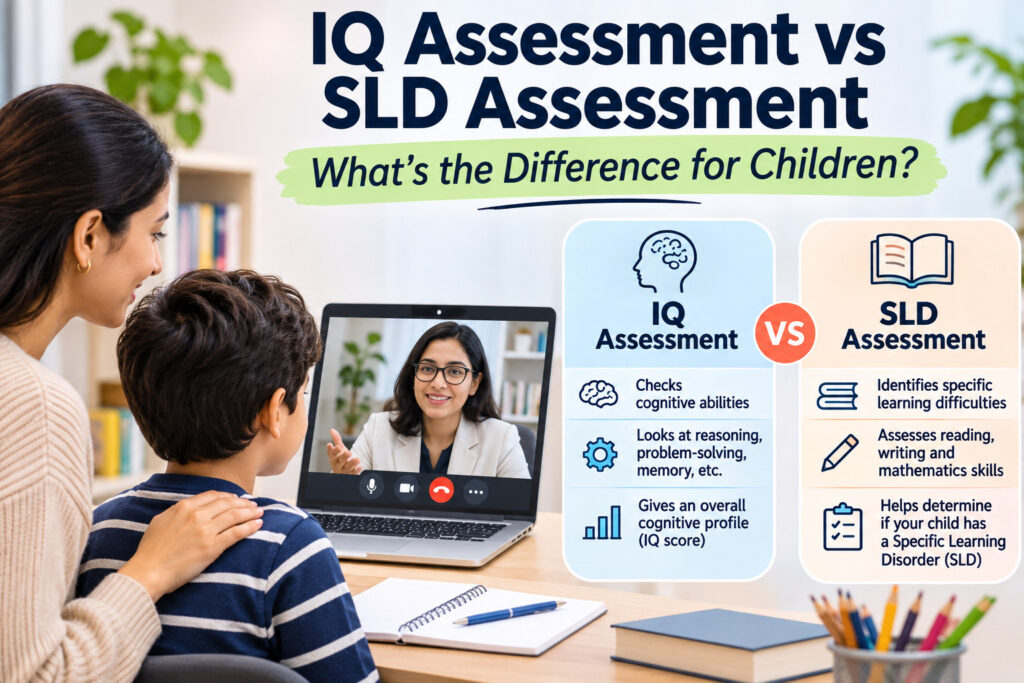
An IQ assessment examines your child’s cognitive abilities, while an SLD assessment investigates persistent difficulties with reading, writing or mathematics.
Sometimes a child needs only one type of evaluation. In other situations, a psychologist may recommend both.
Understanding the difference can help you choose the appropriate assessment rather than booking a test that doesn’t answer your concerns.
IQ Assessment vs SLD Assessment: Key Differences
Here’s a side-by-side comparison to help you understand what each assessment is designed to evaluate.
| Comparison | IQ Assessment | SLD Assessment |
|---|---|---|
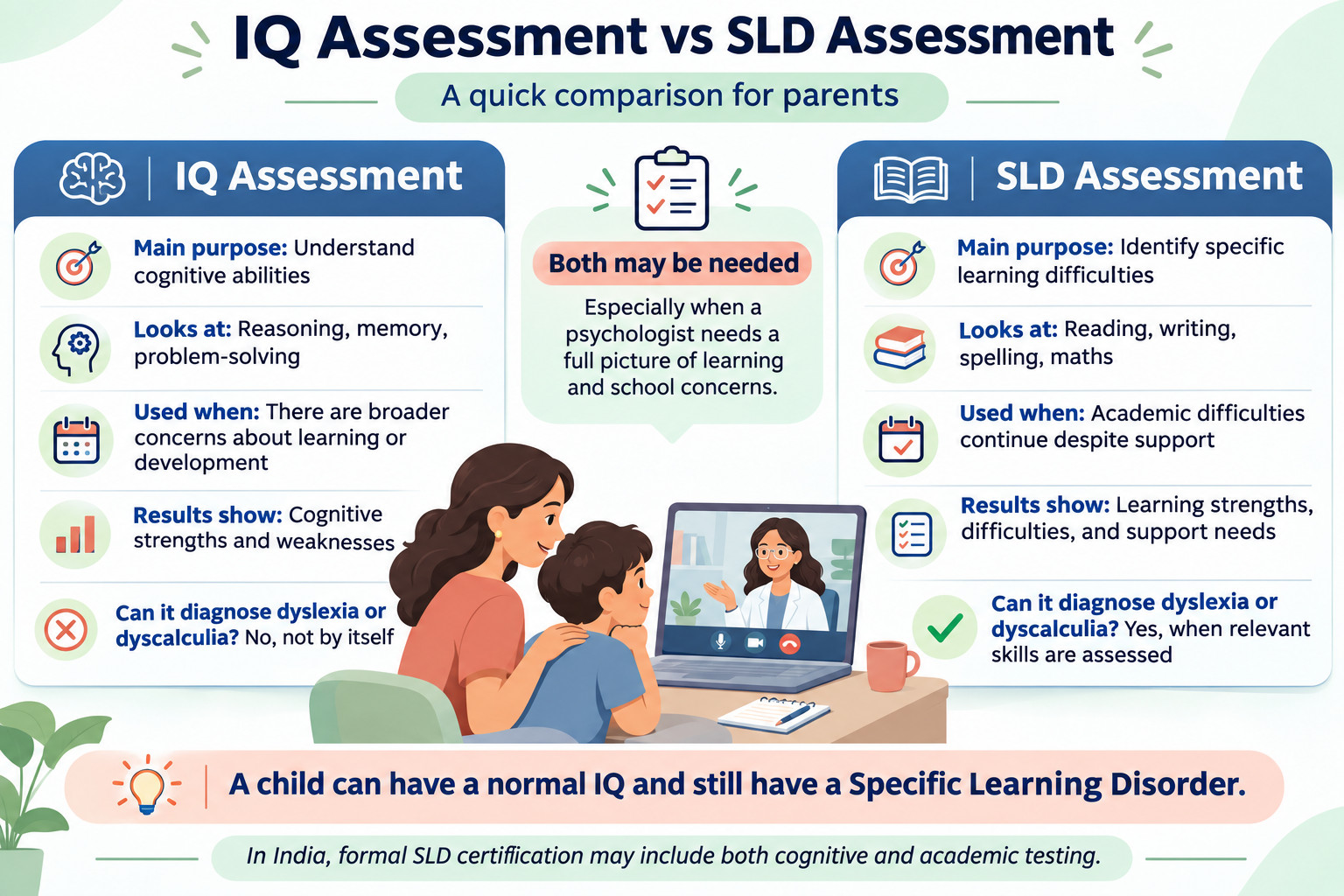
| Main purpose | Understand cognitive abilities | Identify specific academic learning difficulties |
| Skills evaluated | Reasoning, problem-solving, memory and other abilities depending on the test | Reading, spelling, written expression and mathematics |
| Common referral reason | Concerns about cognitive functioning, development or learning across several areas | Persistent problems with particular academic skills |
| Activities involved | Verbal or visual reasoning, memory and problem-solving tasks | Reading, writing, spelling and mathematical activities |
| Results provided | Cognitive ability scores and a profile of strengths and weaknesses | Academic skill findings, diagnostic conclusions and learning recommendations |
| Can it diagnose dyslexia? | No, not independently | Can contribute to diagnosing SLD with impairment in reading |
| Can it identify dyscalculia? | No, not independently | Can evaluate mathematics difficulties consistent with dyscalculia |
| Is IQ testing always necessary? | Depends on the referral | Not always for clinical diagnosis, but included in India’s formal SLD certification pathway |
| Can a child need both? | Yes | Yes |
The main difference is what the professional is trying to understand. One assessment examines how your child approaches cognitive tasks. The other investigates how they’re learning specific academic skills.
An IQ score cannot tell you whether a child has dyslexia, just as poor reading performance cannot establish their overall intelligence.
When Would Your Child Need an IQ Assessment?
An IQ assessment may be recommended when there are concerns about your child’s general cognitive functioning.
For example, their teacher might notice that they struggle to understand new instructions, solve unfamiliar problems or learn concepts across several subjects.
You may also have concerns about their developmental progress or how independently they manage age-appropriate tasks.
A psychologist may use a standardised IQ test to examine areas such as:
- Verbal reasoning: Understanding and working with verbal information.
- Visual or nonverbal reasoning: Recognising patterns and solving problems without relying heavily on language.
- Working memory: Holding and using information for a short period.
- Processing speed: Completing certain simple cognitive tasks efficiently.
The exact areas assessed depend on the instrument being used.
The results help the psychologist understand your child’s cognitive profile. If intellectual developmental disability is being considered, the evaluation must also examine adaptive functioning, not just IQ.
An IQ test doesn’t independently diagnose ADHD, autism or a specific learning disorder.
For more detail about the testing process, PsychiCare explains what happens during an IQ assessment for children.
When Is an SLD Assessment More Appropriate?
Imagine your child understands classroom discussions, remembers what the teacher explains and solves age-appropriate puzzles.
However, when asked to read a paragraph independently, they struggle to recognise words they have practised many times.
In this situation, the main concern may involve reading rather than general cognitive ability.
An SLD assessment investigates persistent difficulties in specific academic areas, including:
- Reading: Word recognition, reading accuracy, fluency and comprehension.
- Written expression: Spelling, grammar, punctuation and organising written work.
- Mathematics: Number sense, arithmetic facts, calculations and mathematical reasoning.
The psychologist also considers your child’s school history, educational opportunities and response to appropriate support.
A child who has missed substantial schooling or received inadequate instruction may need educational support, but their difficulties cannot automatically be classified as an SLD.
Clinical diagnostic criteria generally require persistent difficulties for at least six months despite targeted help, together with evidence that academic skills are substantially below age expectations and affect functioning.
These criteria are explained by the American Psychiatric Association in its guide to Specific Learning Disorders.
If your child’s school has specifically recommended SLD testing, you can read what happens during an SLD assessment before arranging an appointment.
Can a Child Have a Normal IQ and Still Have an SLD?
Yes. A child can have age-appropriate or above-average cognitive abilities and still experience a Specific Learning Disorder.
This is something many parents find confusing.
You might wonder how your child can explain complex ideas, remember detailed conversations or perform well in science but struggle with basic reading or spelling.
The answer is that cognitive abilities and academic learning skills are related, but they’re not identical.
Consider a child who understands stories when someone reads them aloud. They can describe the characters, explain what happened and answer questions correctly.
Yet when asked to read the same story independently, they have difficulty recognising words and reading fluently.
Their understanding may be stronger than their reading accuracy.
An appropriate evaluation can help determine whether this pattern reflects a specific reading disorder or another difficulty.
Does There Need to Be a Gap Between IQ and School Performance?
Not under current DSM-5-TR criteria.
Older approaches sometimes relied on a significant difference between a child’s IQ score and academic achievement.
This was called the IQ–achievement discrepancy model.
Modern clinical criteria do not require this discrepancy to diagnose SLD.
Instead, psychologists examine persistent academic difficulties, standardised achievement results and whether other factors better explain the child’s performance.
This is important because a child should not automatically be denied further learning assessment or support simply because their IQ score falls outside an expected range.
India’s formal disability-certification process has separate prescribed requirements, which we’ll discuss below.
When Might a Psychologist Recommend Both Assessments?
Sometimes academic testing alone doesn’t explain the complete picture.
A psychologist may recommend both IQ and SLD assessments when there are broader concerns about learning or when formal documentation requires them.
Here are three situations that help explain the difference.
Example 1: A Child Struggles With Reading but Learns Other Subjects Well
An eight-year-old understands classroom explanations, enjoys science and answers questions verbally.
However, reading remains slow and difficult despite targeted teaching.
The psychologist may prioritise a detailed reading assessment.
Cognitive testing might be added if the child’s history or other findings indicate a need to examine broader abilities.
An IQ test alone would not establish the cause of the reading difficulty.
Example 2: A Child Struggles Across Several Areas
A ten-year-old has difficulty understanding unfamiliar instructions, learning new concepts and completing age-appropriate tasks independently.
Their problems extend beyond one subject.
In this case, a broader cognitive and developmental evaluation may be necessary.
The psychologist may also assess academic performance to understand how those difficulties affect school learning.
If there are concerns about everyday adaptive functioning, those should be evaluated separately.
Example 3: A School Requests Formal SLD Documentation
A child has experienced persistent reading and writing difficulties, and the school requests formal documentation for educational accommodations.
The family may need to follow India’s prescribed disability-assessment pathway.
That process includes both cognitive and specific academic assessments.
An ordinary IQ report by itself would not meet every requirement of an official SLD certification evaluation.
These examples are illustrative. The appropriate combination of assessments depends on the child’s individual circumstances and the purpose of testing.
Why Are IQ Tests Included in India’s Official SLD Assessment Process?
This is an important difference between clinical diagnosis and government disability certification.
Under international clinical criteria, routine IQ testing is not mandatory for every SLD diagnosis.
However, India’s revised disability assessment guidelines, notified in November 2026, prescribe IQ assessment as part of the formal SLD certification pathway.
The process includes clinical evaluation, cognitive testing and assessment of academic learning difficulties using recognised instruments.
For schoolchildren, the specified academic instruments include the NIMHANS Battery and the NIEPID Grade Level Assessment Instrument for Schools (NIEPID-GLAIS).
The guidelines also include an IQ eligibility criterion for certification.
You can refer to the Government of India’s revised disability assessment guidelines for the official requirements.
Clinical Assessment and Certification Are Not the Same
There are three situations parents should distinguish:
| Purpose | What you need to understand |
|---|---|
| Initial clinical evaluation | What is causing your child’s learning difficulties? |
| Educational assessment | Which academic skills need support, and what teaching adjustments might help? |
| Official SLD certification | Does your child meet the requirements of India’s prescribed statutory process? |
A private psychological assessment does not automatically result in a government-issued disability certificate.
The certification must be completed through the designated authorities and applicable procedures.
Equally, you don’t need to delay asking for help until your child becomes eligible for formal certification.
Teachers and qualified professionals can identify concerns and begin appropriate educational support earlier.
What Do the Two Assessment Reports Tell You?
An IQ assessment and an SLD assessment may produce different types of findings.
An IQ assessment report may describe how your child performed across particular cognitive tasks, including relevant strengths, weaknesses and test scores.
An SLD assessment report focuses more directly on academic learning skills and whether the findings support a diagnosis of Specific Learning Disorder.
For example, an SLD report might explain that your child has significant difficulties with reading accuracy despite appropriate learning opportunities.
It may also identify areas where they perform better, helping teachers plan targeted instruction.
When reviewing either report, ask:
- What did the assessment establish?
- Which abilities or academic skills need support?
- Are additional evaluations recommended?
- What should the school do with these findings?
The report should help you understand your child’s needs, not simply provide a score or diagnostic label.
Which Assessment Should You Book for Your Child?
If your child’s teacher has recommended an assessment, start by asking what they want investigated.
Does the school suspect a specific learning difficulty, or are there broader concerns about development and cognitive functioning?
Before booking, gather the information that will help the psychologist make that decision.
Bring or share:
- The school’s referral or written recommendation.
- Recent report cards and relevant notebooks.
- Previous assessment reports, if available.
- Details of extra teaching or remedial support already attempted.
- Examples of where your child performs well and where they struggle.
You don’t need to decide independently which psychological tests should be administered.
An appropriately qualified professional should review the concerns and recommend a suitable evaluation.
If the school needs official documentation for accommodations, mention that before the appointment so you understand whether a particular certification pathway is required.
PsychiCare’s children’s psychological assessment services can help parents discuss the referral and available assessment options before booking.
Ask which testing procedures are offered, whether any in-person administration is necessary and whether the resulting report meets your school’s requirements.
Frequently Asked Questions
Is an IQ assessment compulsory before an SLD assessment?
Not for every initial clinical evaluation. DSM-5-TR does not require routine IQ testing to diagnose SLD. However, India’s formal SLD disability-certification framework includes prescribed cognitive testing, so the requirements depend on why your child needs the assessment.
Can a child with a high IQ have dyslexia?
Yes. Dyslexia involves specific difficulties with reading-related skills and does not automatically indicate low intelligence. A child may demonstrate strong reasoning or verbal understanding while struggling to decode words or read fluently.
Can an IQ test identify a learning disability?
An IQ test alone cannot diagnose a Specific Learning Disorder. It may provide useful information about cognitive functioning, but diagnosis requires an assessment of academic skills, learning history and other relevant factors.
Does my child need both reports for school accommodations?
That depends on the school, examination board and type of accommodation requested. Formal SLD certification follows prescribed requirements, while some school-level support may be based on educational or clinical recommendations. Ask which documents are accepted before booking.
Can these assessments be completed online?
Some initial interviews and consultations may take place online. However, standardised cognitive and academic testing may require supervised or in-person administration. The psychologist should explain which parts can be completed remotely and whether formal certification requires additional procedures.
Final Thoughts
If your child is struggling at school, getting the right assessment matters more than getting the largest number of tests.
An IQ assessment can help explain cognitive functioning, while an SLD assessment examines particular difficulties with reading, writing or mathematics.
Sometimes both provide useful information.
The best starting point is to explain your child’s difficulties to a qualified psychologist, understand the school’s requirements and choose an assessment that answers the questions you actually have.