Last Updated on November 23, 2026
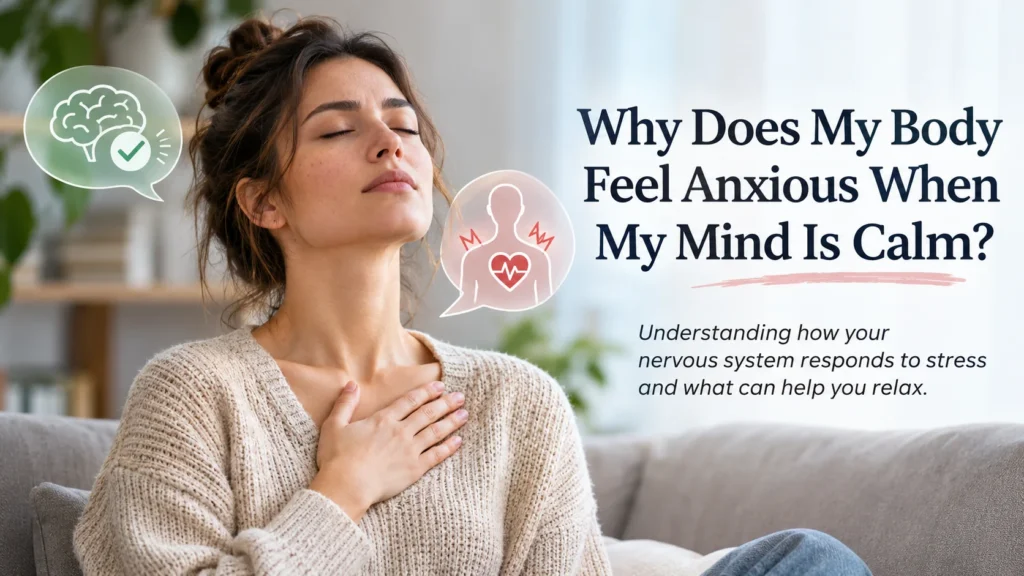
You had a stressful day, but now everything is fine. The work is finished, the argument is over, and there is nothing urgent left to worry about. Yet your heart is still beating fast, your shoulders feel tight, and you cannot seem to relax.
You tell yourself there is nothing to worry about. You might even feel mentally peaceful. But your body does not seem to agree.
This can happen because your mind and body do not always recover from stress at the same speed. Your thoughts may settle quickly, while your nervous system takes longer to return to its usual state.
Understanding why this happens can help you stop fighting these sensations and find better ways to manage them.
Why Does Your Body Stay Stressed After Your Mind Calms Down?
When you face a stressful situation, your body prepares you to respond. Your heart may beat faster, your muscles tighten, and your breathing changes.
This response involves your autonomic nervous system, which controls many automatic body functions.
The sympathetic nervous system helps prepare you for action during stressful situations. The parasympathetic nervous system supports functions associated with rest and recovery.
Your body also releases stress-related hormones, including adrenaline and cortisol.
These changes do not necessarily disappear the moment a stressful situation ends.
Imagine narrowly avoiding a road accident. You know you are safe, but your hands may continue shaking for several minutes. Your heart may still race, and you might remain unusually alert.
Something similar can happen after a difficult conversation, an important meeting, or a long period of emotional pressure.
You may have mentally moved on, but some physical signs of stress can remain.
If you experience this frequently, understanding the difference between stress and anxiety may help you recognise what is happening.
Can You Feel Physically Anxious Without Worrying?
Yes. Physical sensations associated with anxiety can sometimes occur without obvious anxious thoughts.
You might notice:
- A racing heartbeat while sitting quietly.
- Tightness around your neck, jaw, or shoulders.
- Restlessness even when you want to relax.
- Shallow breathing without feeling frightened.
- Stomach discomfort after a stressful day.
- Difficulty falling asleep despite feeling mentally tired.
These sensations do not automatically mean you have an anxiety disorder.
They can have several causes, including stress, poor sleep, caffeine, medications, and medical conditions.
For a more detailed explanation, read PsychiCare’s guide to the physical symptoms of anxiety.
How Your Nervous System and Thoughts Affect Each Other
Your brain constantly receives information from your body.
It notices changes in your heartbeat, breathing, digestion, muscle tension, and other internal sensations.
This process is known as interoception.
Research published in Biological Psychiatry: Cognitive Neuroscience and Neuroimaging explains how interoception plays an important role in emotional experiences and mental health.
The interesting part is that the same physical sensation can mean different things in different situations.
For example, your heart might race because you are excited about meeting someone. But if you notice the same heartbeat while resting, you may start wondering whether something is wrong.
That worry can make you more alert to the sensation, which may increase your discomfort.
Why Checking Your Symptoms Can Make Them Feel Worse
Suppose you notice that your breathing feels slightly unusual.
You start paying close attention to every breath. Then you wonder whether you are breathing deeply enough.
The more you monitor your breathing, the more uncomfortable it may begin to feel.
A similar pattern can happen with your heartbeat, stomach sensations, or muscle tension.
This does not mean the symptoms are imaginary. It means your attention and interpretation can influence how you experience them.
If you frequently find yourself trapped in repetitive thoughts, PsychiCare’s article on how to stop overthinking explains ways to recognise these patterns.
Why Telling Yourself to Relax Does Not Always Work
Have you ever tried telling yourself to calm down, only to feel more frustrated?
You know you are safe, so you expect your body to relax immediately. When that does not happen, you begin wondering why.
The problem is that relaxation is not something you can always achieve through reasoning alone.
Your body responds to sleep, movement, breathing, physical comfort, and many other influences.
Sometimes changing your thoughts helps. At other times, a gentle physical activity or a period of rest may be more useful.
This is why psychologists often consider both cognitive and physical aspects of stress management.
1. Try Gentle Breathing Exercises
Breathing exercises can help some people manage feelings of tension.
You can try sitting comfortably, breathing at a natural pace, and gently extending your exhalation without forcing deep breaths.
A 2023 study published in Cell Reports Medicine examined brief daily breathing exercises and mindfulness meditation.
Researchers found that exhalation-focused cyclic sighing was associated with greater improvements in mood and reductions in respiratory rate than the mindfulness comparison group.
However, breathing exercises work differently for different people.
If paying close attention to your breathing makes you uncomfortable, you can choose another relaxation technique.
2. Release Muscle Tension
Stress often makes you tighten your muscles without noticing.
You may clench your jaw, raise your shoulders, or sit with your back tense for hours.
Progressive muscle relaxation is one technique that involves gently tightening and releasing different muscle groups.
You can also try stretching, walking, or taking regular breaks from sitting.
These activities may help reduce physical tension without requiring you to focus constantly on your thoughts.
3. Give Your Body Time to Recover
Many people finish work and immediately start scrolling through their phones, answering messages, or planning the next day.
Although the stressful task has ended, their attention remains busy.
Try creating a short period between work and rest.
You might listen to quiet music, spend time outside, read something enjoyable, or simply sit somewhere comfortable.
You do not need to make every minute productive.
Sometimes relaxation begins when you stop expecting yourself to achieve something.
4. Avoid Constantly Monitoring Your Body
Checking whether your heartbeat has slowed or your muscles have relaxed can sometimes become another source of worry.
Instead of measuring how calm you feel every few minutes, try focusing on an ordinary activity you enjoy.
The goal is to let your attention move away from repeatedly evaluating your physical state.
Can Vagus Nerve Stimulation Help With Relaxation?
The vagus nerve is an important part of your autonomic nervous system. It helps carry signals between your brain and several internal organs and is involved in functions such as digestion and heart rate regulation.
Researchers have been studying whether stimulating certain branches of this nerve can influence physiological responses.
One approach is called transcutaneous auricular vagus nerve stimulation, or taVNS.
This method delivers low-level electrical stimulation through specific areas of the outer ear.
Some wellness companies now offer devices based on this technology.
For example, ZenoWell has developed a wearable vagus nerve stimulator for use in wellness and relaxation routines.
Its Luna series uses an ear-based stimulation device with adjustable settings, while Luna Plus includes additional app-based features.
However, it is important to understand that research into taVNS for stress relief is still developing.
What Does the Research Say?
A 2025 study involving 41 healthy young adults examined how taVNS affected responses to a stressful mental arithmetic task.
Researchers observed some changes in physiological measurements, including heart rate variability and electrodermal activity.
However, the study did not find significant improvements in participants’ reported stress or cognitive performance.
This distinction matters.
A device may influence a physiological measurement without necessarily making someone feel calmer.
It is also important not to assume that results from one stimulation method or research device apply to every commercial product.
Wearable stimulation devices should not be viewed as replacements for psychological therapy or established medical treatment.
How to Choose a Relaxation Method That Works for You
There is no single relaxation technique that works for everyone.
The most useful approach often depends on how you experience stress.
If you struggle with racing thoughts: Journalling, mindfulness, or cognitive techniques may help you recognise repetitive thinking patterns.
If your body feels tense: Gentle movement, stretching, or progressive muscle relaxation may be more comfortable.
If you feel overstimulated: A quieter environment, fewer notifications, and sensory grounding may help reduce demands on your attention.
If you struggle to follow a routine: Guided exercises or structured relaxation sessions may make it easier to set aside time for rest.
Some people also explore wellness technologies, including breathing guides, massage products, biofeedback wearables, and electrical stimulation devices.
When choosing a stress relief device, consider the technology it uses, the evidence supporting its claims, its safety instructions, and whether it fits your daily routine.
A complicated routine is not necessarily better than a simple one.
What matters is finding an approach that feels manageable and supports your needs.
Why Trying Too Hard to Relax Can Increase Stress
Sometimes, relaxation becomes another task on your daily checklist.
You sit down to meditate and expect to feel calm within ten minutes.
When you still feel tense, you get frustrated.
You start checking your breathing, heartbeat, or muscle tension to see whether the exercise is working.
Instead of helping you relax, the process creates another thing to worry about.
This is especially relevant for people who are sensitive to physical sensations.
A more practical approach is to stop treating relaxation as a performance.
You do not have to eliminate every uncomfortable sensation.
You can simply create a comfortable environment, reduce unnecessary demands, and give yourself time to recover.
Some days you may feel relaxed quickly. Other days you may need more time.
Neither experience means you have failed.
When Should You Speak to a Mental Health Professional?
Occasional physical tension after stressful situations is common.
However, you should consider professional support if your symptoms repeatedly interfere with sleep, work, relationships, or everyday activities.
You may also benefit from speaking with a psychologist if you frequently experience unexplained fear, persistent worry, or a strong urge to monitor your physical symptoms.
Cognitive Behavioural Therapy (CBT) is one evidence-based approach used to treat anxiety disorders.
It can help you understand the connection between thoughts, physical sensations, and behaviours.
You can learn more about how Cognitive Behavioural Therapy works and how it helps people respond differently to anxiety.
At PsychiCare, our psychologists provide online anxiety counselling for people dealing with persistent worry, physical anxiety symptoms, emotional stress, and related concerns.
Treatment can focus on identifying triggers, understanding unhelpful patterns, and developing practical coping strategies.
Remember that persistent or unexplained physical symptoms should not automatically be attributed to anxiety. Medical assessment may be necessary, particularly for new or worsening symptoms. Severe chest pain, fainting, or serious breathing difficulties require urgent medical attention.
Final Thoughts: Your Body Does Not Have to Feel Calm All the Time
Feeling physically anxious when your mind is calm can be frustrating, especially when you cannot identify anything to worry about.
But your body and mind do not always respond to stress in exactly the same way.
Your thoughts may settle before your heartbeat, breathing, or muscle tension returns to its usual state.
The aim is not to force yourself to feel calm every moment of the day. Stress responses are a normal part of how your body works.
What matters is learning to recognise your patterns, allowing time for recovery, and knowing when additional support may help.
Sometimes a quiet walk, comfortable breathing, or a proper break is enough. At other times, understanding recurring anxiety patterns with a qualified professional can make a meaningful difference.
References
- Ottaviani C, Thayer JF, Verkuil B, et al. Physiological concomitants of perseverative cognition: a systematic review and meta-analysis. Psychological Bulletin. 2016;142(3):231–259.
- Khalsa SS, Adolphs R, Cameron OG, et al. Interoception and mental health: a roadmap. Biological Psychiatry: Cognitive Neuroscience and Neuroimaging. 2018;3(6):501–513.
- Drost L, Schulz A, Möck A, Vögele C. Effects of taVNS on physiological responses and cognitive performance during a mental stressor. Cognitive, Affective, & Behavioral Neuroscience. 2025.
- Balban MY, Neri E, Kogon MM, et al. Brief structured respiration practices enhance mood and reduce physiological arousal. Cell Reports Medicine. 2023;4(1):100895.