Last Updated on November 23, 2026
Your child has been practising multiplication tables for weeks. They remember the answers one evening but struggle with the same questions the next morning.
You try explaining the sums differently. Their teacher gives them extra worksheets. Yet even simple calculations continue to take much longer than expected.
You may wonder whether your child needs more practice or whether something else is making mathematics difficult.
This is where a dyscalculia assessment can help.
A dyscalculia assessment examines how your child understands numbers, performs calculations and solves mathematical problems. It helps determine whether their difficulties are consistent with a specific learning disorder or could be explained by other factors.
The goal isn’t simply to find out how good your child is at maths. It’s to understand which skills are difficult, why they may be struggling and what kind of support could help.
When Should Your Child Have a Dyscalculia Assessment?
Every child struggles with maths occasionally. A difficult chapter, missed lessons or an unfamiliar teaching method can affect performance.
However, persistent difficulties with basic numerical concepts may need closer attention.
You might notice that your child finds it difficult to compare numbers, understand place value or remember simple arithmetic facts.
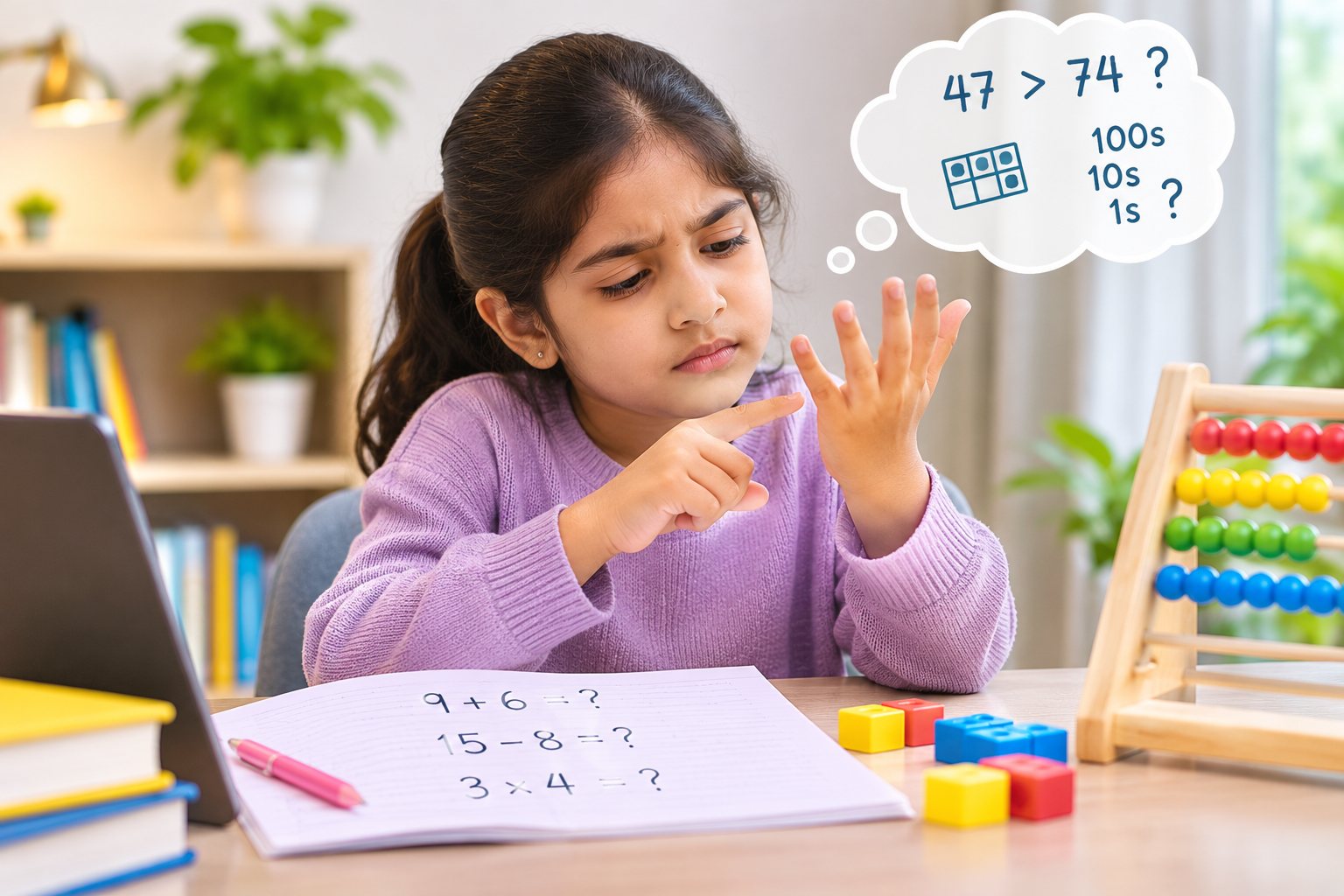
For example, they may know how to count to 100 but struggle to recognise whether 47 is greater than 74.
Some children continue counting on their fingers for calculations their classmates can solve mentally. Others understand how to add numbers but repeatedly forget multiplication facts they have practised.
These difficulties become more concerning when they continue despite appropriate teaching and targeted support.
An assessment may also be appropriate when mathematical difficulties significantly affect your child’s schoolwork or confidence.
You don’t need to wait for repeated examination failures. If your child’s teacher has identified persistent concerns, discussing an assessment can help clarify the next step.
How Is Dyscalculia Assessed in Children?
A dyscalculia assessment involves more than asking your child to solve a set of maths questions.
The psychologist examines different mathematical skills to understand where the child experiences difficulty.
Assessment activities are selected according to the child’s age, educational level, language and learning history.
1. Understanding Numbers and Quantities
One important area is number sense.
This refers to how children understand quantities, numerical relationships and the meaning of numbers.
Your child may be asked to compare two groups of objects, arrange numbers in order or identify where a number belongs on a number line.
For example, a psychologist might show a number line from 0 to 100 and ask your child to indicate approximately where 60 belongs.
Some children can recite numbers in the correct order but struggle to understand their relative sizes.
The psychologist looks at whether these difficulties are persistent and unexpected for the child’s age and learning experience.
2. Checking Place Value and Number Relationships
Place value is another skill that may be examined.
A child might be asked to explain what the digits represent in the number 304.
Do they understand that the 3 represents three hundreds, while the 4 represents four ones?
Some children can read numbers correctly but find it difficult to understand how tens, hundreds and thousands relate to one another.
These difficulties can affect subtraction with borrowing, multiplication and more advanced mathematical concepts.
The assessment helps distinguish a misunderstanding of place value from an occasional calculation mistake.
3. Assessing Arithmetic Facts and Calculation Skills
Your child may complete addition, subtraction, multiplication and division tasks appropriate for their school level.
The psychologist examines how accurately and efficiently they work.
For example, a child may understand that 9 + 6 means combining two quantities but need to count each number individually to reach the answer.
Another child might quickly remember that 9 + 6 = 15 but struggle to explain or apply the same relationship using objects.
These differences provide information about arithmetic fact retrieval and conceptual understanding.
The assessor may also observe whether your child loses track of steps, repeatedly changes calculation methods or makes similar errors across several activities.
One wrong answer doesn’t establish a learning disorder. The pattern across different tasks is more informative.
4. Evaluating Mathematical Reasoning
Not all maths difficulties involve basic calculations.
Some children can complete familiar sums correctly but struggle when they need to decide which mathematical operation to use.
Imagine your child is asked:
A notebook costs ₹35. You pay ₹50. How much change should you receive?
The assessor may observe whether your child recognises that subtraction is needed.
If they struggle, the psychologist considers whether the problem involves mathematical reasoning, understanding the question or carrying out the calculation.
A child who can solve the problem when it is explained verbally may have different learning needs from one who struggles even when the numbers are presented clearly.
This helps the professional understand the skills behind the child’s performance rather than relying only on the final answer.
How Do Psychologists Interpret Different Maths Mistakes?
Two children can receive the same low score on a mathematics test but have very different difficulties.
Consider these examples.
Child A understands calculations but struggles with number magnitude.
They can complete familiar addition problems but have trouble deciding which of two unfamiliar numbers is larger.
Their assessment may reveal difficulties understanding numerical quantities and relationships.
Child B understands quantities but struggles to recall arithmetic facts.
They know what multiplication means and can demonstrate it using groups of objects. However, recalling basic multiplication facts takes considerable effort.
Their assessment may show a different pattern involving arithmetic fluency.
Child C calculates accurately but struggles with word problems.
They can solve a subtraction problem when the operation is written clearly but cannot always identify the correct operation from a written question.
The psychologist may need to investigate mathematical reasoning, reading comprehension and language skills.
These examples don’t represent diagnoses.
They show why a dyscalculia assessment should examine individual mathematical abilities rather than treating all poor maths performance as the same problem.
Understanding these differences also helps teachers choose more appropriate methods of instruction.
How Do Psychologists Confirm a Dyscalculia Diagnosis?
Dyscalculia is commonly used to describe difficulties associated with Specific Learning Disorder with impairment in mathematics.
Under DSM-5-TR, the diagnosis involves persistent difficulties in academic learning that significantly affect performance.
For mathematics, these difficulties may involve number sense, arithmetic facts, accurate or fluent calculations, or mathematical reasoning.
The psychologist considers whether problems have continued for at least six months despite targeted help.
They also examine whether the child’s mathematical abilities are substantially below expectations for their age and whether the difficulties interfere with schoolwork or everyday functioning.
Standardised achievement testing and comprehensive clinical assessment help establish this.
You can read the American Psychiatric Association’s explanation of Specific Learning Disorders for more information about the diagnostic criteria.
Importantly, a low maths score alone cannot confirm dyscalculia.
A diagnosis requires the professional to consider the child’s learning history, educational opportunities, assessment results and other possible explanations.
Can Maths Anxiety, ADHD or Dyslexia Affect the Assessment?
Yes. This is why dyscalculia assessment sometimes involves looking beyond mathematics.
A child with maths anxiety may become distressed during timed calculations or examinations, affecting how well they perform.
Another child may have ADHD and struggle to maintain attention during multi-step problems.
Reading difficulties can also affect maths performance, especially when questions involve written instructions or word problems.
For example, if your child understands a maths question when you read it aloud but struggles when reading it independently, their language or reading abilities may need further evaluation.
These conditions can also occur together.
A child may have dyscalculia alongside ADHD, dyslexia or maths anxiety.
A comprehensive assessment considers the full learning picture rather than assuming that one difficulty explains everything.
If your child is experiencing problems across several school subjects, PsychiCare’s guide to what happens during an SLD assessment explains how broader learning difficulties are evaluated.
Which Tests Are Used to Assess Dyscalculia in India?
The tests used depend on your child’s age, educational background and the purpose of the assessment.
A psychologist may use age-appropriate standardised mathematical achievement measures alongside clinical interviews, school information and observations.
For formal Specific Learning Disability assessment under India’s revised November 2026 disability guidelines, recognised instruments include the NIMHANS Battery and the NIEPID Grade Level Assessment Instrument for Schools (NIEPID-GLAIS).
These instruments are used within the prescribed government assessment framework for schoolchildren.
The official pathway also includes cognitive assessment and evaluation of factors that could explain the learning difficulties.
However, an initial clinical or educational evaluation is not necessarily identical to the process required for government disability certification.
If your child’s school has recommended testing, ask whether it needs an educational assessment report or documentation issued through an authorised government certification process.
This helps you select the appropriate provider and avoid unnecessary appointments.
Who Can Assess Dyscalculia in Children?
The professional involved depends on the type of evaluation your child requires.
An appropriately qualified clinical psychologist can assess learning difficulties, examine cognitive and academic functioning, and determine whether further specialist evaluation is necessary.
A trained special educator may assess academic performance, identify learning gaps and recommend suitable educational support.
Some children also require input from other professionals, such as a developmental paediatrician or psychiatrist, particularly when other developmental or behavioural concerns are present.
For official disability certification in India, the assessment must follow the notified procedures and involve the designated authorities.
Before booking, explain whether you need a clinical opinion, school recommendations or formal documentation for educational provisions.
How to Understand Your Child’s Dyscalculia Assessment Results
An assessment report should help you understand what your child can do independently and where learning becomes difficult.
It may identify weaknesses in number sense, place value, arithmetic fact retrieval, calculation fluency or mathematical reasoning.
These findings are important because different difficulties may require different teaching approaches.
For example, a child struggling with numerical quantities may benefit from structured activities using number lines, visual comparisons and physical objects.
A child who understands multiplication but cannot recall facts efficiently may require systematic teaching and carefully planned practice.
If reading difficulties are affecting mathematical word problems, the school may need to address those skills as well.
The report should also explain whether the findings meet diagnostic criteria, whether additional evaluation is recommended and what educational support may be appropriate.
When reviewing the report, ask the psychologist which mathematical skills should be prioritised and how improvement can be monitored.
The purpose of assessment is not simply to assign a label. It is to identify the support that matches your child’s learning needs.
Is Dyscalculia Assessment Different From Disability Certification in India?
Yes. This is an important distinction for parents.
A clinical or educational assessment helps identify mathematical learning difficulties and guide appropriate support.
Government disability certification involves a separate statutory process with specific eligibility criteria, approved assessment methods and designated certifying authorities.
India’s revised guidelines were notified on 18 November 2026 and published on 19 November 2026.
The guidelines provide for school screening at eight years of age or in Class III, whichever is earlier, followed by the prescribed assessment process when appropriate.
Formal certification has additional requirements that do not automatically apply to every initial clinical evaluation.
You can consult the Government of India’s revised disability assessment guidelines for the official requirements.
You don’t need to delay seeking help for a younger child who is already experiencing mathematical learning difficulties.
Early concerns can be discussed with teachers and qualified professionals, and educational support can begin before formal disability certification is considered.
If cognitive testing has been recommended, PsychiCare’s article on when a child should get an IQ assessment explains when this type of evaluation may be useful.
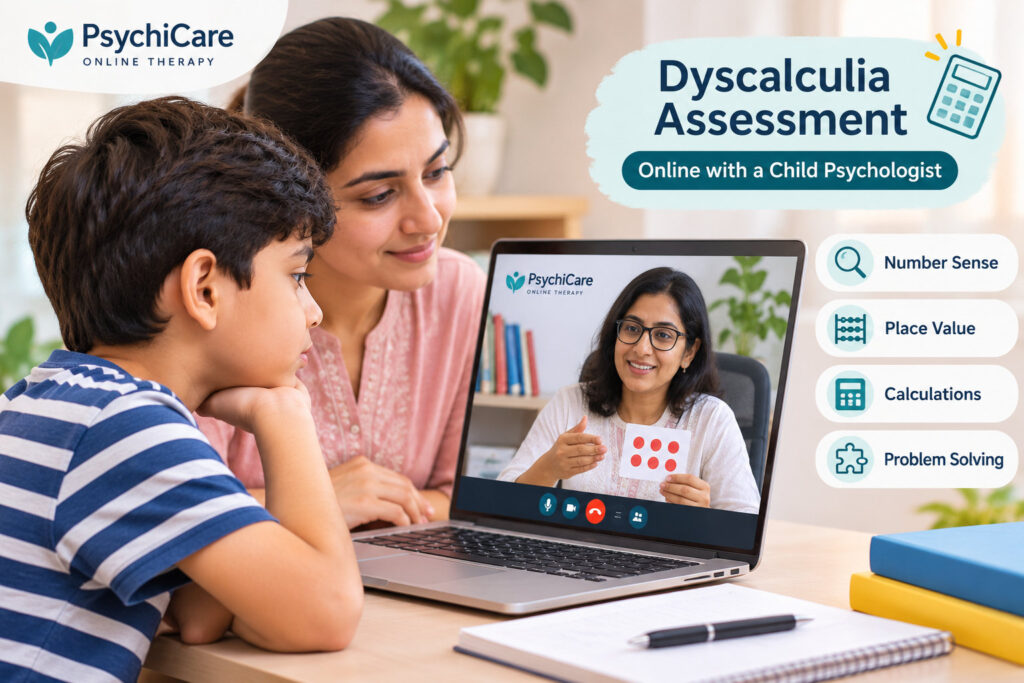
Can Dyscalculia Be Assessed Online?
An online consultation can help parents understand whether their child’s mathematical difficulties warrant further evaluation.
A psychologist may review school reports, discuss the child’s learning history and explain which assessments could be appropriate.
However, completing an online questionnaire does not establish a clinical diagnosis.
Some standardised tests require controlled administration and may need to be completed in person.
The professional should explain which parts of the evaluation can take place online and whether an in-person appointment is necessary.
PsychiCare’s children’s psychological assessment services can be a starting point if you are unsure what type of evaluation your child needs.
You can discuss the difficulties, the school’s concerns and the available assessment options before deciding how to proceed.
Frequently Asked Questions
At what age should a child be assessed for dyscalculia?
A child can be evaluated when persistent mathematical difficulties become apparent. The type of assessment depends on their age, schooling and learning experience. You should not delay seeking guidance simply because your child is younger than the age at which formal school screening or disability certification procedures may apply.
Does every child with dyscalculia need an IQ test?
An IQ test is not automatically necessary for every initial educational or clinical evaluation. Broader cognitive testing may be recommended when the psychologist needs to understand the child’s overall abilities. India’s formal SLD disability assessment framework has additional prescribed cognitive testing requirements.
Is there one test that confirms dyscalculia?
No. A diagnosis requires more than one score. The psychologist considers mathematical performance, educational history, persistence of difficulties and other possible explanations.
How long does a dyscalculia assessment take?
The duration depends on your child’s age, the areas requiring evaluation and the testing methods used. Some assessments involve more than one appointment. Ask the provider about the expected process and report before booking.
Can a child receive help without a dyscalculia diagnosis?
Yes. Teachers can provide targeted mathematical instruction based on the difficulties they observe. A formal diagnosis may help clarify the learning profile, but children do not have to wait for one before receiving appropriate educational support.
Final Thoughts
If your child struggles with mathematics despite repeated practice, the next step isn’t necessarily another workbook or extra tuition.
Understanding which mathematical skills are difficult can help you make better decisions about their learning.
A dyscalculia assessment looks beyond marks to examine how your child understands numbers, completes calculations and approaches problems.
With a clearer picture of their strengths and difficulties, you and their teachers can choose support that addresses the skills they actually need help developing.